
News & Announcements
Specialized Pro-Resolving Mediators and Eicosanoids: A Solid-Phase Extraction Protocol from Tissues and Biological Fluids
Article from 2019-10-09
Charlotte C. Jouvene and Charles N. Serhan
Brigham and Women’s Hospital and Harvard Medical School, Boston, MA
Following infection and/or injury, the acute inflammatory response is a protective mechanism initiated by the host. Ideally, complete resolution of inflammation allows a return to homeostasis.1 Lipid mediators have crucial roles in both initiation of inflammation and its timely resolution. The cardinal signs of inflammation are initiated by specific eicosanoids, e.g., prostaglandins and leukotrienes (Figure 1), stimulating responses such as neutrophil recruitment. As a reflection of the neutrophil-monocyte sequence, a lipid mediator class switching occurs with the biosynthesis of specialized pro-resolving mediators (SPMs).2 These SPMs include arachidonic acid (AA)-derived lipoxins (LX), eicosapentaenoic acid (EPA)-derived E-series resolvins (RvE), and docosahexaenoic acid (DHA)-derived D-series resolvins (RvD), protectins (PD), and maresins (MaR) that each limit neutrophil tissue infiltration and stimulate non-phlogistic monocyte recruitment, allowing complete resolution of inflammation and a return to homeostasis (Figure 1).2,3 These potent mediators of resolution represent a challenge for quantitative extraction, notably due to their fragile physical properties and their picogram to nanogram bioactive concentration ranges in tissues.2,3
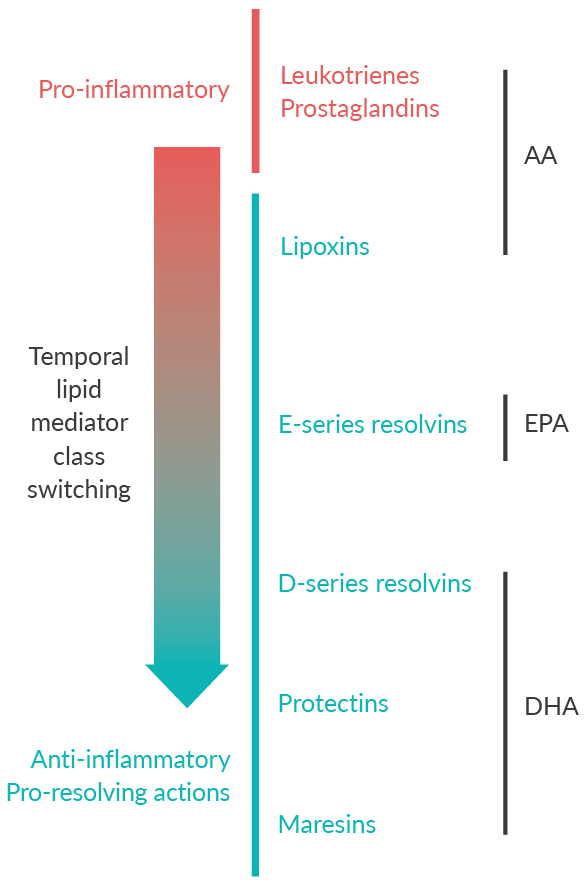
Figure 1. Inflammation-resolution time course: lipid mediator class switching during inflammatory processes. Pro-inflammatory prostaglandins and leukotrienes are biosynthesized from arachidonic acid during initiation of inflammation. Later, pro- resolving mediators (lipoxins, E-series resolvins, D-series resolvins, protectins, and maresins) are actively biosynthesized during the resolution phase.
Liquid-liquid extraction (LLE), one of the most widely used lipid extraction strategies, involves the use of immiscible organic solvents to extract phospholipids, fatty acids, triacylglycerols, etc.4,5 An often-used method using a mix of chloroform, methanol, and water was introduced by Folch et al.6,7 and modified by Bligh and Dyer (Figure 2).8
Figure 2. Liquid-Liquid Extraction
Although effective for phospholipids and fatty acid extraction, this method does not achieve selective extraction of eicosanoids and SPMs. Selective retention of eicosanoids and SPMs can be done by their different interactions between a solid phase and a liquid mobile phase during solid-phase extraction (SPE) (see outline of the current procedures used by our laboratory, Figure 3). Moreover, SPE is preferred over traditional LLE because it is a rapid procedure that uses less solvent and is more selective.9
Figure 3. Steps to extract SPMs effectively from a tissue or a biological fluid. As a precaution, tissues and/or biological fluids should either be directly prepared for the extraction after harvesting or rapidly snap frozen before storage at -80°C to reduce potential autoxidation and hydrolysis. Samples should always be kept on ice to prevent isomerization of the lipid mediators.
Steps for Maximal Recovery
(Note this procedure is tissue-dependent and routinely gives >85-95% recovery for IS that are ideally deuterium-labeled.)
- Add IS-containing ice-cold methanol to sample. Methanol enables the separation of lipids from proteins after homogenization, and appropriate IS are used for the identification and the quantification of SPMs and eicosanoids (see Lipid Mediator Metabololipidomics LC-MS-MS Spectra Book 2019 (PDF)).10
- Keep tissues or biological fluids at -20°C for 45 min to allow protein precipitation.
- After centrifugation (1,000 x g, 10 min, 4°C), if necessary, bring the sample volume down to ~1 ml with a gentle stream of nitrogen.
- Extract lipid mediators by automatic SPE (ExtraheraTM, Biotage®):
- Condition the C18 columns (Isolute® SPE 100 mg, Biotage®) used for SPE with 5-10 ml* methanol and 5-10 ml* water. Other C18 columns such as Bond Elut C18 (Agilent) or Sep-Pak C18 (Waters) can be used.
- Load the samples (water pH 3.5/methanol 9:1).
- Rapidly (<30 sec) wash the column with 5-10 ml* water to return to an apparent neutral pH ~7.0 (to be tested before extraction). This step reduces acid induced isomerization, loss of analytes, and lactone formation, e.g., 5-HETE, etc.
- Wash with hexane to elute more polar lipids.
- Elute SPMs and eicosanoids with 5-10 ml* of methyl formate.
*Optimized for 30 mg of tissue. - Remove the solvent with a gentle stream of nitrogen.
- Resuspend in methanol/water (50:50) prior to LC-MS/MS injection.
Good handling and appropriate conditions for the sample extractions are as important as the LC-MS/MS settings used for lipid mediator analysis. Detailed information can be found in these references.4,5,10-13
You May Also Be Interested In
 Specialized Pro-Resolving Mediators |  Resolving Inflammation in COVID-19 |
Article References
1. Ward, P.A., Acute and chronic inflammation. Fundamentals of inflammation. Serhan, C.N., Ward, P.A., and Gilroy, D.W., editors. 1st edition, Cambridge University Press (2010).
2. Serhan, C.N. Pro-resolving lipid mediators are leads for resolution physiology. Nature 510(7503), 92-101 (2014).
3. Serhan, C.N. Discovery of specialized pro-resolving mediators marks the dawn of resolution physiology and pharmacology. Mol. Aspects Med. 58, 1-11 (2017).
4. Gunstone, F.D., Harwood, J.L., and Padley, F.B. The Lipid Handbook, Second Edition, Chapman and Hall, London, (1994).
5. Okuno, T. and Yokomizo, T. Basic techniques for lipid extraction from tissues and cells. Bioactive Lipid Mediators: Current reviews and protocols. Yokomizo, T. and Murakami, M, editors. 1st edition, Springer (2015).
6. Folch, J., Ascoli, I., Lees, M., et al. Preparation of lipide extracts from brain tissue. J. Biol. Chem. 191(2), 833-841 (1951).
7. Folch, J., Lees, M., and Sloane Stanley, G.H. A simple method for the isolation and purification of total lipides from animal tissues. J. Biol. Chem. 226(1), 497-509 (1957).
8. Bligh, E.G. and Dyer, W.J. A rapid method of total lipid extraction and purification. Can. J. Biochem. Physiol. 37(8), 911-917 (1959).
9. Powell, W.S. Extraction of eicosanoids from biological fluids, cells, and tissues. Methods Mol. Biol. 120, 11-24 (1999).
10. Riley, I., Norris, P.C., Luong, K., et al. CET&RI Spectra Book & Physical Properties of SPM and Eicosanoids 2019, http://serhanlab.bwh.harvard.edu/wp-content/uploads/2019/05/UPDATED-2019-Spectra-Book.pdf.
11. Dalli, J., Colas, R.A., Walker, M.E., et al. Lipid mediator metabolomics via LC-MS/MS profiling and analysis. Methods Mol. Biol. 1730, 59-72 (2018).
12. English, J.T., Norris, P.C., Hodges, R.R., et al. Identification and profiling of specialized pro-resolving mediators in human tears by lipid mediator metabolomics. Prostaglandins Leukot. Essent. Fatty Acids 117, 17-27 (2017).
13. Norris, P.C. and Serhan, C.N. Metabololipidomic profiling of functional immunoresolvent clusters and eicosanoids in mammalian tissues. Biochem. Biophys. Res. Commun. 504(3), 553-561 (2018).
About the Authors
Charlotte C. Jouvene, Ph.D.
Dr. Jouvene obtained her degree in biochemistry in France and is currently a post-doctoral fellow and visiting scientist at the Center for Experimental Therapeutics and Reperfusion Injury (CET&RI) at Brigham and Women’s Hospital and Harvard Medical School.
Charles N. Serhan, Ph.D., D.Sc.
Charles N. Serhan is Professor and Director of the CET&RI at Brigham and Women’s Hospital. He is also the Simon Gelman Professor of Anesthesia (Biochemistry & Molecular Pharmacology) at Harvard Medical School and Professor of Oral Medicine, Infection and Immunity at Harvard School of Dental Medicine.
Contact Info
Cayman Chemical1180 East Ellsworth RoadAnn Arbor, Michigan 48108 USAToll Free: (800) 364-9897(USA and Canada only)Fax: (734) 971-3640


