
News & Announcements
Sphingolipid Shorthand
Article from 2018-03-28
Understanding Cayman’s lipid nomenclature
Lipids are named in two ways: 1) by systematic names and 2) by common/trivial names. Lipid systematic names are defined by the International Union of Pure and Applied Chemistry and the International Union of Biochemistry and Molecular Biology (IUPAC-IUBMB) Commission on Biochemical Nomenclature. Common names (especially in the form of abbreviations), while not as consistent as the IUPAC system, are generally adopted since they tend not to be as cumbersome. The most useful trivial names offer the convenience of shortened names while at the same time supplying at-a-glance information of the distinguishing features of the lipid in question. Such considerations must be made for abbreviations used to describe sphingolipids, whose basic defining characteristic is an 18-carbon chain with two or three hydroxyl groups and often, a distinctive trans-double bond at the C4 position. Here at Cayman, we have updated our common-name nomenclature system to help provide a more consistent description. The main updates involve clarification of the aliphatic chain length of the sphingoid backbone along with the number of double bonds and any accompanying fatty chain additions, number of hydroxyl groups, and stereochemistry (i.e., D-erythro, L-erythro, L-threo, or D-threo geometries). Key features of our sphingolipid naming scheme are noted in Figure 1 using C18 Ceramide (d18:1/18:0) as an example.
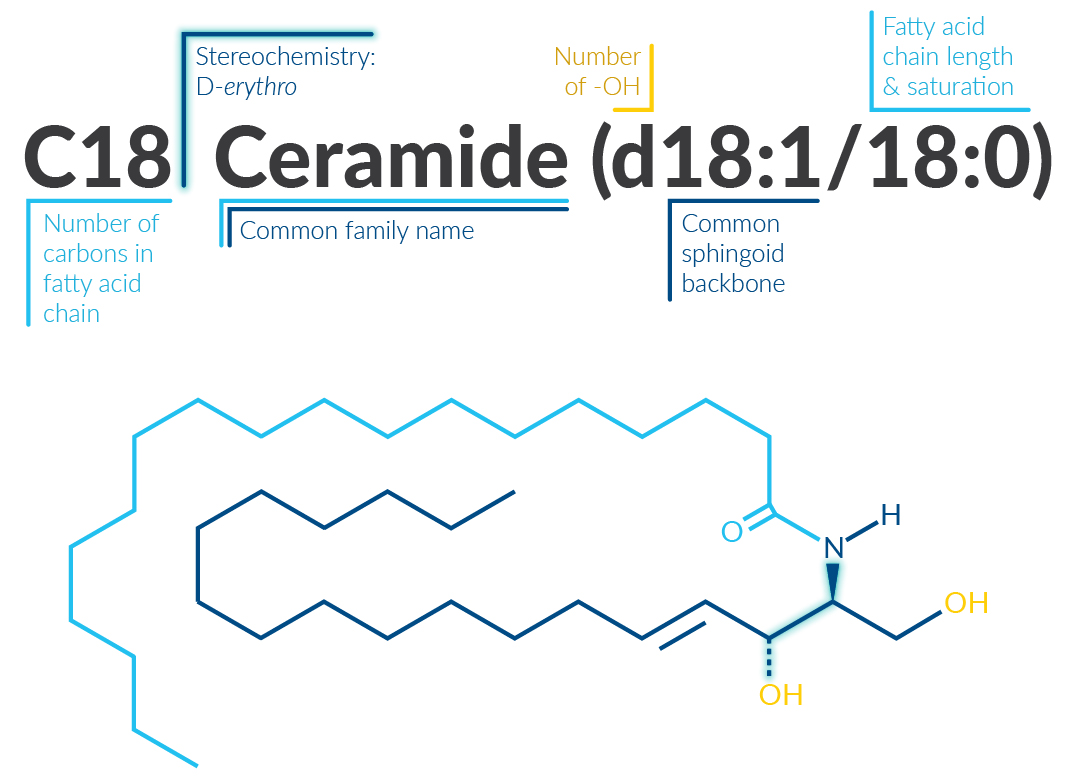
Figure 1. C18 Ceramide (d18:1/18:0) is shown as a visual for how to quickly decipher Cayman’s sphingolipid shorthand.
Name Overview
The number of carbons in the fatty acid acyl chain are noted preceding the common name of ceramides and sphingomyelins. Since basic sphingosines lack the acyl chain, they will not have a carbon number listed (see Ceramide v. Sphingosine below). Further details of the configuration of the aliphatic and acyl side chains are indicated within parenthesis at the end of the common name using a shorthand commonly used for fatty acids.
Sphingoid backbone
Within the parenthesis, the common sphingoid backbone (i.e., sphingosine, sphinganine, phytosphingosine, or sphingadiene, Table 1) is represented first, supplying information on aliphatic chain length and degree of saturation (i.e., zero, one, or two double bonds, respectively).
Table 1. Common Sphingoid Bases
| Shorthand | Common Name | Historic Name | Comments |
|---|---|---|---|
| d18:1 | Sphingosine | (4E-sphingenine) | most common in animal tissues |
| d18:0 | Sphinganine | (dihydrosphingosine) | saturated analog of sphingosine |
| t18:0 | Phytosphingosine | (4D-hydroxy-sphinganine) | common long-chain base in plants |
| d18:2 | Sphingadiene | Sphinga-4E,xE-dienine | x = double bond can occur at positions 8, 11, or 14 in addition to the 4E double bond |
Amount of hydroxylation
The prefix ‘m’, 'd', or 't' is included prior to the sphingoid base number to designate 1 monohydroxy, 1,3 dihydroxy-, or 1,3,4 trihydroxy bases, respectively. The traditional backbone of most mammalian sphingolipids contains 2-amino, 1,3-diols. Fungi and plant sphingolipids contain an additional hydroxyl group at the C4 position (Figure 2).
Figure 2. C18 Phytoceramide (t18:0/18:0) is a bioactive sphingolipid found in S. cerevisiae, wheat grains, and mammalian skin. It contains a phytosphingosine backbone, which bears three OH groups. This lipid is used in cosmetics as a skin protectant as it reduces water loss to prevent skin dehydration and irritation.
Recently, it has been discovered that many organisms can additionally produce non-traditional, cytotoxic 1-deoxysphingoid bases. These unusual sphingoid bases lack a hydroxyl group in the C1 position (Figure 3).
Figure 3. 1-deoxysphingolipids are monohydroxylated. 1-Deoxysphinganine can be rapidly acylated to 1-deoxyceramides with very uncommon biophysical properties, but not more complex sphingolipids because of the missing OH group.
Fatty acid chain
If additional acyl chains are present, their length is supplied within the final portion of the parenthesis, defining the total number of carbon atoms and degree of saturation in the additional acyl chains. A unique example of two different fatty acid chain additions can be seen with the esterified omega-hydroxyacyl-sphingosine EOS (d18:1/32:1/18:2). It contains the essential fatty acid linoleic acid esterified to the ω-hydroxy of a very long chain fatty acid linked at the N-acyl moiety to a ceramide base (Figure 4).
Figure 4. EOS (d18:1/32:1/18:2) is a sphingosine (18:1) with an ω-hydroxy very long-chain fatty acid (32:1) esterified to linoleic acid (18:2). The consecutive regio- and stereospecific oxygenation of the linoleate portion of EOS by 12(R)-lipoxygenase and eLOX3 is essential for the maintenance of the epidermal barrier to prevent water loss.
Stereochemistry
Sphingolipids occur naturally in the D-erythro (2S,3R) configuration. Thus, a D-erythro prefix is not included in the common name. Because synthetic sphingoids differ from the natural stereochemistry at either the C2 and/or C3 positions, the prefix L-erythro, D-threo, or L-threo has been included in the name for further clarification (e.g., C6 L-erythro Ceramide (d18:1/6:0), C6 D-threo Ceramide (d18:1/6:0), C6 L-threo Ceramide (d18:1/6:0)).
Ceramide v. Sphingosine
The term sphingolipid blankets a broad class of lipids such that extra clarification is needed to specify individual family members. For a majority of the sphingolipids, the sphingoid base is linked via the amine group to a fatty acid, including saturated and 2-hydroxy components (Figure 1). This configuration defines a ceramide. A polar head group can be attached to the primary hydroxyl moiety to produce more complex ceramides, which will be discussed below (see Complex Sphingolipids). An important distinction from ceramides are simple sphingosines, which are not acylated by fatty acids. Bearing the signature amino diol carbon chain with one double bond in position 4, sphingosines can be recognized as the prevalent backbone of many higher order sphingolipids common in animal tissues (Figure 5).
Figure 5. Sphingosine (d18:1) lacks the fatty acid chain common to all ceramides.
Since the fatty acid chain is absent, a carbon number does not precede the common name as we have done for our ceramide shorthand convention. The potent bioactive lipid sphingosine-1-phosphate (d18:1) is a prominent example of a sphingosine base modified with an added polar head group.
Sphingolipid Analytical Standards: noting deuterium placement
The position of deuterium atoms on isotopically labeled sphingolipids is noted after the chain (i.e., sphingoid backbone or the fatty acid acyl chain) on which the isotopes are attached (Figure 6).
Figure 6. C18 Ceramide-d7 (d18:1-d7/18:0) contains seven heavy hydrogens at the end of the 18:1 sphingoid base. C18 Ceramide-d3 (d18:1/18:0-d3) contains three heavy hydrogens at the end of the 18:0 N-acyl chain.
Complex Sphingolipids
Higher order sphingolipids possess more complex modifications at the primary hydroxyl moiety of the ceramide base (Figure 7). Nonetheless, the shorthand naming convention we established with the simple ceramides and sphingosines still applies using the common name of the complex sphingolipid base in place of the simple ceramide or sphingosine.
Figure 7. Higher order sphingolipids depicted symbolically to demonstrate complexity and compare similarities of added headgroups to the ceramide base unit.
- Sphingomyelins consist of a ceramide unit with a phosphorylcholine moiety attached to the C1 position (e.g., C18 Sphingomyelin (d18:1/18:0)).
- Cerebrosides include the natural monoglycosylceramides: galactosylceramide and glucosylceramide. Either a galactose (e.g., C12 Galactosylceramide (d18:1/12:0)) or glucose (e.g., C22 Glucosylceramide (d18:1/22:0)) unit is attached to the C1 position of ceramide.
- Lactosylceramides have a disaccharide attached to the C1 position of the ceramide unit (e.g., C17 Lactosylceramide (d18:1/17:0)).
- Gangliosides are oligoglycosylceramides (i.e., multiple carbohydrate moieties attached to a ceramide unit) that contain a sialic acid residue (e.g., Ganglioside GM1).
- Sulfatides are glycosphingolipids carrying a sulfate ester group attached to the carbohydrate moiety (e.g., C12 3'-sulfo Galactosylceramide (d18:1/12:0)).
View complete details on all sphingolipids available from Cayman
Suggested Reading
Chester, M.A. IUPAC-IUB Joint Commission on Biochemical Nomenclature (JCBN) Nomenclature of glycolipids: Recommendations 1997. Carbohydr. Res. 312, 167-175 (1998).
Duan, J. and Merrill, A.H., Jr. 1-Deoxysphingolipids encountered exogenously and made de novo: Dangerous mysteries inside an enigma. J. Biol. Chem. 290(25), 15380-15389 (2015).
Merrill, A.H., Jr. De novo sphingolipid biosynthesis: A necessary, but dangerous, pathway. J. Biol. Chem. 277(29), 25843-25846 (2002).
Zheng, Y., Yin, H., Boeglin, W.E., et al. Lipoxygenases mediate the effect of essential fatty acid in skin barrier formation: A proposed role in releasing omega-hydroxyceramide for construction of the corneocyte lipid envelope. J. Biol. Chem. 286(27), 24046-24056 (2011).
Contact Info
Cayman Chemical1180 East Ellsworth RoadAnn Arbor, Michigan 48108 USAToll Free: (800) 364-9897(USA and Canada only)Fax: (734) 971-3640


