
News & Announcements
The Biological Role of Sulfatides
Article from 2019-12-02
This article was originally published in the December 2019 edition of Matreya’s Newsletter for Glyco/Sphingolipid Research (PDF).
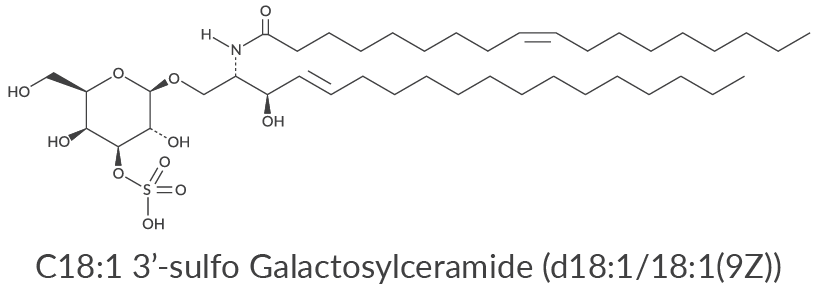
Sulfatides are 3’-sulfated galactosylceramides that are found primarily on oligodendrocytes, renal tubular cells, and some tumor cells. They are prominently involved in nerve conduction and cell adhesion, although many other cellular functions have been observed. Sulfatides can induce intracellular signaling in neutrophils through an L-selectin-dependent pathway and provide a binding site for human immunodeficiency virus, Helicobacter pylori, and malaria sporozoites. In the brain and spinal cord, sulfatides have different molecular species of varying fatty acyl chains containing saturated, unsaturated, and 2-hydroxy fatty acids, the composition of which are vital for influencing their function. Over the last several decades, sulfatides have been linked to many physiological processes and recently there has been a renewed interest in their role in diseases.
Demyelinating Diseases
Both sulfatide and its metabolic precursor galactosylceramide are present at high concentrations in multilamellar layers of the myelin surrounding the axons of neuronal cells where they are involved in nerve conduction. The production of anti-sulfatide antibodies in the cerebrospinal fluid, leading to a deficiency in sulfatides, may be a cause of degeneration of the myelin sheath, leading to multiple sclerosis and other demyelinating diseases.1
Platelet Aggregation
Sulfatides interact with several cell adhesion molecules such as laminin, thrombospondin, von Willebrand factor, and selectin.2 They have recently been identified as a major ligand for P-selectin in platelet adhesion aggregation, which is necessary for the formation of stable platelet aggregates. Platelets expressing sulfatides were found to adhere to P-selectin, while platelets expressing P-selectin adhered to sulfatides. When sulfatide presence was masked by forming sulfatide micelles or introducing sulfatide-binding recombinant malaria circumsporozoite protein, the adhesion was inhibited. The role of sulfatide/P-selectin interaction may play a significant role in hemostasis and thrombosis.3
Leukotriene Synthesis
In adherent human polymorphonuclear leukocytes, sulfatides have been found to suppress leukotriene synthesis by directly inhibiting 5-lipoxygenase and impeding its translocation to the nuclear envelope. The mechanism for this inhibition may be due to sulfatide causing a redistribution of cholesterol, increasing its abundance at the uropod region.4
Ovarian Tumors
Cancerous cells are known to present unusually high levels of glycosphingolipids. Sulfatides have been identified as being present at elevated levels in ovarian tissues of patients with advanced ovarian tumors. The elevated levels of sulfatide in these cells may play a role in the pathogenesis of ovarian cancer. These elevated sulfatide levels in tissue biopsies can be used as a biomarker to predict the presence of advanced stage ovarian cancer even when the patient otherwise appears to be in the early stage of the disease.5
Available Sulfatides
- Sulfatides (bovine) (sodium salt)
- 3’-sulfo Galactosylsphingosine (ammonium salt)
- C2 3'-sulfo Galactosylceramide (d18:1/2:0)
- C16 3'-sulfo Galactosylceramide (d18:1/16:0)
- C18 3'-sulfo Galactosylceramide (d18:1/18:0)
- C18 3'-sulfo Lactosylceramide (d18:1/18:0)
- C18:1 3'-sulfo Galactosylceramide (d18:1/18:1(9Z))
- C24 3'-sulfo Galactosylceramide (d18:1/24:0)
- C24:1 3'-sulfo Galactosylceramide (d18:1/24:1(15Z))
- C12 NBD 3'-sulfo Galactosylceramide (d18:1/12:0)
- C18 3'-sulfo Galactosylceramide-d3 (d18:1/18:0-d3)
References
1. Halder, R.C., Jahng, A., Maricic, I., et al. Mini review: Immune response to myelin-derived sulfatide and CNS-demyelination. Neurochem. Res. 32(2), 257-262 (2007).
2. Borthakur, G., Cruz, M.A., Dong, J.F., et al. Sulfatides inhibit platelet adhesion to von Willebrand factor in flowing blood. J. Thromb. Haemost. 1(6), 1288-1295 (2003).
3. Merten, M. and Thiagarajan, P. Role for sulfatides in platelet aggregation. Circulation 104(24), 2955-2960 (2001).
4. Grishina, Z.V., Pushkareva, M.A., Pletjushkina, O.Y., et al. Sulfatides inhibit leukotriene synthesis in human polymorphonuclear granulocytes by a mechanism involving lipid rearrangement in intracellular membranes. Int. J. Biochem. Cell Biol. 40(1), 110-124 (2008).
5. Makhlouf, A.M., Fathalla, M.M., Zakhary, M.A., et al. Sulfatides in ovarian tumors: Clinicopathological correlates. Int. J. Gynecol. Cancer 14(1), 89-93 (2004).
Contact Info
Cayman Chemical1180 East Ellsworth RoadAnn Arbor, Michigan 48108 USAToll Free: (800) 364-9897(USA and Canada only)Fax: (734) 971-3640


