
News & Announcements
Xylazine-laced Fentanyl: The Deadly Combination Sweeping Across the United States
Article from 2023-04-28
The veterinary tranquilizer xylazine is sweeping across the United States at an alarming rate, and concerns over the growing number of xylazine-related overdoses have led the Biden administration to declare xylazine-laced fentanyl an emerging threat in the United States.1
Xylazine Exposure
Xylazine is a non-opioid sedative and muscle relaxant used in veterinary medicine as an animal tranquilizer (lending it the street name "tranq") that is associated with sharp increases in drug overdose fatalities in the United States.2 It is most often found in mixtures with fentanyl, but xylazine has also been found as a co-drug with other drugs of abuse like heroin, cocaine, methamphetamine, and benzodiazepines.2 It has also been misused in its pure form, although infrequently.3
Xylazine is inexpensive, easy to access, and mimics some opioid-like effects.2,4 Some users of fentanyl containing xylazine (known as "tranq dope") report that xylazine gives fentanyl a more heroin-like effect, increasing both the intensity and duration of euphoric effects.2 However, the combination of xylazine and fentanyl is deadly. Both drugs act as respiratory and central nervous system (CNS) depressants, increasing the risk of overdose.5 Because it is not an opioid, xylazine overdose cannot be reversed by opioid antagonists like naloxone and naltrexone. So far, there are no human antidotes for xylazine overdose, and medical treatment is limited to supportive care.
Prevalence in the United States
While xylazine has appeared occasionally in forensic casework since the 1980s, it emerged in prominence in the early 2000s in Puerto Rico as "anestesia de caballo" (horse anesthetic).2,5,6 It surfaced on the United States mainland in the mid-2010s in Philadelphia, largely acknowledged as being the epicenter of the current crisis, spreading from the Northeastern United States to infiltrate the South, Midwest, and Western regions.2,7 Now, the DEA reports that they have seized xylazine and fentanyl mixtures in 48 of 50 states.8
The number of xylazine-positive overdose deaths increased in all four US Census regions from 2020 to 2021 (Figure 1):7
- Northeast (103%)
- South (1,127%)
- Midwest (516%)
- West (750%)
Figure 1. Geographic distribution of xylazine-positive overdose deaths* in the United States.
*Xylazine-positive overdose deaths are where xylazine was detected in decedent postmortem toxicology. Counts are included regardless of if xylazine was indicated in the cause of death.7
The possibility exists that these numbers may be underreported as xylazine may not be included in routine postmortem toxicological testing. Though, efforts are underway to improve xylazine surveillance.
| "One of the challenges is that previously, testing for xylazine was not occurring in the laboratories. Since most labs at the state level have started testing for xylazine, we're seeing more of it across the country," said Orville Greene, Special Agent in charge of the DEA Detroit Field Division in a press conference held on April 18, 2023.9 |
Mechanism of Action & Toxicity
Xylazine is an α2-adrenergic receptor agonist, resulting in respiratory depression, CNS depression, hypotension, and hyperglycemia, among other negative health effects (Figure 2).3 It has a vasoconstrictive effect on local blood vessels (such as those used for intravenous administration), leading to reduced perfusion, skin ulcers, tissue necrosis, and heightened risk of infection.10
Figure 2. Summary of xylazine health consequences.
Metabolism
Pharmacokinetic data on human xylazine metabolism are limited but can be inferred from animal studies. Xylazine is rapidly absorbed, metabolized in the liver, and eliminated in the urine.11 The onset of effects is rapid, and the elimination half-life ranges from 22 to 51 minutes. Because of this quick elimination, which results from extensive metabolism rather than elimination of the untransformed product, xylazine can be difficult to detect in biological samples.11-13
Xylazine undergoes extensive metabolism via N- and S-dealkylation, oxidation, and/or hydroxylation to phase I metabolites, followed by glucuronidation or sulfation to phase II metabolites.14 2,6-Dimethylaniline (2,6-DMA) is frequently cited as the predominant metabolite of xylazine, but this metabolite is also a product of lidocaine and thus, is not selective for xylazine.
Emerging Threats
The Combating Illicit Xylazine Act, introduced to Congress in March 2023, calls for xylazine to be regulated as a Schedule III drug under the Controlled Substances Act.15 If passed, it would help stop the emerging threat posed by xylazine by equipping the DEA with the authority to restrict and track the illicit manufacturing, distribution, and possession of xylazine.
Some states have adopted their own regulations to stop the spread of xylazine. It is regulated as a Schedule I drug in Florida, and Ohio and Pennsylvania, have or intend to regulate it as a Schedule III drug.16-18 West Virginia has also recently passed legislation that will regulate xylazine as a Schedule IV drug.19
There is concern that another veterinary sedative, medetomidine, is on the rise in the United States. Medetomidine, a racemic mixture of dexmedetomidine and levomedetomidine, has been found in samples from Maryland, Pennsylvania, Florida, Missouri, and Ohio in combination with xylazine, fentanyl, and cocaine, among others.20,21
Whether or not medetomidine and other veterinary sedatives will sweep across the United States like xylazine remains to be seen, but nevertheless, it highlights the importance of continual monitoring and surveillance by federal, state, and local partners to identify these emergent drugs.
Xylazine is exacerbating the third wave of the opioid epidemic, one that has been dominated by synthetic opioids, especially fentanyl and its analogs. Despite decreases in the number of prescription opioid-related deaths, the number of synthetic opioid-related overdoses continues to rise.22 Polysubstance use, whether knowingly or unknowingly by the user, is suspected to be a contributing factor.
FAS Kits & Additional Resources
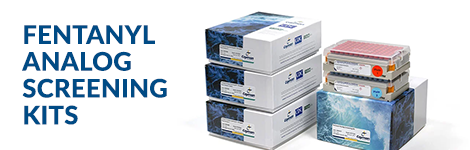
To help combat the ongoing opioid epidemic, the Centers for Disease Control (CDC) and Cayman Chemical have released a new addition to the Traceable Opioid Material® Kits (TOM Kits®) product line that expands testing laboratory capabilities beyond synthetic opioids to include additional emerging drugs of abuse. The FAS Kit - Emergent Drug Panel (EDP) expands testing laboratory capabilities to detect and identify additional emerging drugs of abuse. The expanded panel includes 60 synthetic opioids, stimulants, hallucinogens, benzodiazepines, and synthetic cannabinoids, as well as xylazine. This panel is distinct from the previous FAS Kit and FAS Kit - Emergent Panels as it includes compounds frequently encountered as co-drugs in samples containing fentanyl and other synthetic opioids.
Cayman provides many additional resources to support the detection and identification of emerging drugs of abuse. We keep abreast of new analogs that appear in forensic casework or on the grey market and respond quickly to provide a reference standard. If you are having trouble identifying or finding a compound of interest, please contact our technical support department. Cayman can also provide assistance in the identification of unknown compounds and provides other tools on our Forensic Science Products page such as our Spectral Library, GC-MS Search Tool, and tips for interpreting GC-MS of unknown fentanyls to help chemists identify novel analogs.
You May Also Be Interested In
| |
References
1. Biden-Harris administration designates fentanyl combined with xylazine as an emerging threat to the United States. In: The White House. ONDCP Press Release (2023). Available from: whitehouse.gov/ondcp/briefing-room
2. Friedman, J., Montero, F., Bourgois, P., et al. Xylazine spreads across the US: A Growing component of increasingly synthetic and polysubstance overdose crisis. Drug Alcohol Depend. 233, 109380 (2022).
3. Ruiz-Colón, K., Chavez-Arias, C., Díaz-Alcalá, J.E. et al. Xylazine intoxication in humans and its importance as an emerging adulterant in abused drugs: A comprehensive review of the literature. Forensic Sci. Int. 240, 1-8 (2014).
4. Ayub, S., Parnia, S., Poddar, K. et al. Xylazine in the opioid epidemic: A systematic review of case reports and clinical implications. Cureus 15(3), e36864 (2023).
5. Ruiz-Colón, K., Martinez, M.A., Silva-Torres, L.A., et al. Simultaneous determination of xylazine, free morphine, codeine, 6-acetylmorphine, cocaine and benzoylecgonine in postmortem blood by UPLC–MS-MS. J. Anal. Toxicol. 363, 319-326 (2012).
6. Poklis, A., Mackell, M.A., and Case, M.E.S. Xylazine in human tissues and fluids in a case of fatal drug abuse. J. Anal. Toxicol. 9(5), 234-236 (1985).
7. United States Department of Justice, Drug Enforcement Administration. The growing threat of xylazine and its mixture with illicit drugs. DEA Joint Intelligence Report (2022).
8. United States Department of Justice, Drug Enforcement Administration. DEA reports widespread threat of fentanyl mixed with xylazine. dea.gov/alert/dea-reports-widespread-threat-fentanyl-mixed-xylazine (2023).
9. United States Department of Justice, Drug Enforcement Administration. DEA speaks on xylazine-laced fentanyl. DEA Press Conference, facebook.com/wwmtnews/videos/6319034644785053 (2023).
10. Malayala, S.V., Papudesi, B.N., Bobb, R., et al. Xylazine-induced skin ulcers in a person who injects drugs in Philadelphia, Pennsylvania, USA. Cureus 14(8), e28160 (2022).
11. Garcia-Villar, R., Toutain, P.L., Alvinerie, M., et al. The pharmacokinetics of xylazine hydrochloride: An interspecific study. J. Vet. Pharmacol. Ther. 4(2), 87-92 (1981).
12. Kariisa, M., Patel, P., Smith, H., et al. Notes from the field: Xylazine detection and involvement in drug overdose deaths – United States, 2019. MMWRMorb. Mortal. Wkly. Rep. 70(37), 1300-1302 (2021).
13. Saisahas, K., Soleh, A., Promsuwan, K., et al. A portable electrochemical sensor for detection of the veterinary drug xylazine in beverage samples. J. Pharm. Biomed. Anal. 198, 113958 (2021).
14. Meyer, G.M.J. and Maurer, H.H. Qualitative metabolism assessment and toxicological detection of xylazine, a veterinary tranquilizer and drug of abuse, in rat and human urine using GC-MS, LC-MSn, and LC-HR-MSn. Anal. Bioanal. Chem. 405(30), 9779-9789 (2013).
15. The United States Congress. H.R.1839 - Combating Illicit Xylazine Act. 118th Congress, 1st Session. (2023).
16. The 2022 Florida Statutes (including 2022 special session A and 2023 special session B). In: Online Sunshine. The Florida Legislature (2022). Available from: leg.state.fl.us/statutes
17. Governor DeWine authorizes emergency classification of xylazine as schedule III controlled substance. In: Mike DeWine, Governor of Ohio. Office of the Governor, State of Ohio (2023). Available from: governor.ohio.gov/media/news-and-media
18. Governor Shapiro directs administration to schedule xylazine as a controlled substance, taking action against dangerous drug contributing to opioid overdoses. In: Governor Josh Shapiro. Commonwealth of Pennsylvania, The Governor (2023). Available from: governor.pa.gov/newsroom
19. Stuart, M., Woodrum, J., Deeds, V., Taylor, J., Maynard, M.R., and Hamilton, B. 2023 Regular session engrossed committee substitute for senate bill 546. In: West Virginia Legislature. Office of Reference & Information (2023). Available from: wvlegislature.gov/Bill_Status/bills_text.cfm?billdoc=sb546%20sub1%20eng.htm&yr=2023&sesstype=RS&i=546
20. Sisco, E. and Appley, M. Identification of the veterinary sedative medetomidine in combination with opioids and xylazine in Maryland. J. Forensic Sci. (2023).
21. United States Department of Justice, Drug Enforcement Administration. Announcement of an emerging compound: Medetomidine. NFILS DEA Synth-Opioids Forum (2023).
22. Ciccarone, D. The rise of illicit fentanyls, stimulants, and the fourth wave of the opioid overdose crisis. Curr. Opin. Psychiatr. 34(4), 344-350 (2021).
Contact Info
Cayman Chemical1180 East Ellsworth RoadAnn Arbor, Michigan 48108 USAToll Free: (800) 364-9897(USA and Canada only)Fax: (734) 971-3640


