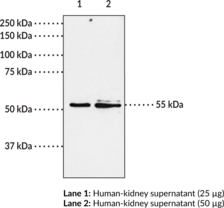
For immunochemical detection of BLT1
Technical Support & Resources

Visit our FAQ

Contact Us

Toll Free Phone (USA and Canada Only): (888) 526-5351
Direct Phone: (734) 975-3888

Request Technical Support

Technical Support Request

To streamline the process attach the appropriate questionnaire to your inquiry.

Download IHC QuestionnaireDownload WB Questionnaire

View Our Privacy Statement for details on how we use and protect your data. In addition, this site is protected by hCaptcha and its Privacy Policy and Terms of Service apply.

BLT1 Receptor Polyclonal Antiserum

Item No. 100019

Product Insert (PDF)
Technical Information
Synonyms
  • BLTR1
  • Leukotriene B4 Receptor 1
  • LTB4 Receptor 1
Immunogen
Synthetic peptide from the C-terminal region of human BLT1
Polyclonal antiserum
Storage Buffer
Polyclonal antiserum when reconstituted in 100 µl of deionized water
Host
Rabbit
Applications
CF, FC, IHC (formalin-fixed paraffin-embedded tissue), and WB
Species Reactivity
(+) Human(+) Bovine(-) Mouse
UniProt Accession №
Q15722
Origin
Animal/Rabbit
Shipping & Storage Information
Storage
-20°C
Shipping
Wet ice in continental US; may vary elsewhere
Recommended Products

Certificates of Analysis & Batch Specific Data

Provide batch numbers separated by commas to download or request available product inserts, QC sheets, certificates of analysis, data packs, and GC-MS data.

    Add

    Lipid Resource Center
    Discover Products & Resources for Lipid Research
    • High-purity lipid standards
    • Lipid roles in biology
    • Lipids in health & disease
    • Lipids for pharmaceutical development
    • Protocols, advice, & resources
    EXPLORE NOW
    Product Description

    The leukotriene B4 receptor 1 (BLT1 receptor), cloned from HL-60 human leukemia cells, has 352 amino acids and seven putative membrane-spanning domains.1 The primary structure of the receptor is identical to that of a putative purinoceptor, P2Y7, which binds to micromolar concentrations of ATP.2 Northern blotting reveals that the BLT1 receptor is highly expressed in leukocytes, U937 cells, and to a much lower extent in spleen and thymus.1 Sheep lung membranes have also been identified as a rich source for receptor isolation and purification.3 A second LTB4 receptor, BLT2, has recently been cloned and characterized.4,5,6 Cayman Chemical’s BLT1 receptor polyclonal antiserum is made against a peptide from the C-terminus of the BLT1 receptor, which is located on the intracellular side of the plasma membrane. Therefore, when performing studies on whole cells, permeabilization of the cells is required for the antibody to enter the cytosol. The antiserum is recommended for immunohistochemical analysis of BLT1 receptor expression in tissues of human and bovine origin. Successful recognition of the overexpression of BLT1 in pancreatic ductal cells of human chronic pancreatitis and pancreatic cancer patients has been documented using this antiserum.1

    WARNING This product is not for human or veterinary use.

    References & Product Citations
    Product Description References

    1. Yokomizo, T., Izumi, T., Chang, K., et alA G-protein-coupled receptor for leukotriene B4 that mediates chemotaxis. Nature 387(6633), 620-624 (1997).

    2. Akbar, G.K.M., Dasari, V.R., Webb, T.E., et alMolecular cloning of a novel P2 purinoceptor from human erythroleukemia cells. The Journal of Biological Chemisty 271(31), 18363-18367 (1996).

    3. Votta, B., Keefer, J., and Mong, S. Characterization of the soluble leukotriene B4 receptor from sheep lung membranes. Biochem. J. 270(1), 213-218 (1990).

    4. Yokomizo, T., Kato, K., Terawaki, K., et alA second leukotriene B4 receptor, BLT2: A new therapeutic target in inflammation and immunological disorders. J. Exp. Med. 193(3), 421-431 (2000).

    5. Kamohara, M., Takasaki, J., Matsumoto, M., et alMolecular cloning and characterization of another leukotriene B4 receptor. The Journal of Biological Chemisty 275(35), 27000-27004 (2000).

    6. Wang, S., Gustafson, E., Pang, L., et alA novel hepatointestinal leukotriene B4 receptor. The Journal of Biological Chemisty 275(52), 40686-40694 (2000).