
Technical Support & Resources
Visit our FAQ
Contact Us
Toll Free Phone (USA and Canada Only): (888) 526-5351
Direct Phone: (734) 975-3888
Product Categories

Technical Information
- Catenin (Cadherin-associated Protein), Beta 1
- CTNNB1
- EVR7
- MRD19
- NEDSDV
Shipping & Storage Information
Recommended Products
Certificates of Analysis & Batch Specific Data
Provide batch numbers separated by commas to download or request available product inserts, QC sheets, certificates of analysis, data packs, and GC-MS data.

Visit Our Cancer Resource Center
Find Tools & Resources to Study the Hallmarks of Cancer
- Cancer cell signaling & regulation
- Cancer metabolism
- Tumor microenvironment
Product Description
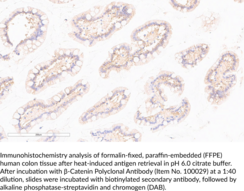
β-Catenin is a transcriptional coactivator that is encoded by the CTNNB1 gene in humans.1,2 It is a 781 amino acid protein comprised of an N-terminal domain containing glycogen synthase kinase 3β (GSK3β) phosphorylation sites, a C-terminal transactivation domain, and a central domain spanning amino acid residues 138-664.3,4 The central domain consists of 12 armadillo repeats and is required for binding to cadherins, TCF/LEF transcription factors, and adenomatous polyposis coli (APC). β-Catenin has roles in cell adhesion, canonical Wnt signaling, regulation of stem cells, embryonic development, and adult tissue homeostasis, among others.1,3 In the absence of Wnt, a complex consisting of axin, APC, GSK3β, and casein kinase 1 (CK1), binds to and phosphorylates β-catenin, targeting it for ubiquitination and proteosomal degradation.1 In the presence of Wnt, phosphorylation of β-catenin is inhibited, allowing β-catenin to translocate into the nucleus, where it interacts with TCF/LEF to activate expression of Wnt target genes. Activating mutations in CTNNB1 that stabilize β-catenin have been associated with a variety of cancers, including hepatocellular and adrenocortical carcinomas, colorectal cancer, and pilomatricomas.5,4,6,7 Cayman's β-Catenin Polyclonal Antibody can be used for immunohistochemistry (IHC) and Western blot (WB) applications.
WARNING This product is not for human or veterinary use.
References & Product Citations
1. Wnt/β-
2. Genomic organization of the human β-
3. Crystal structure of a full-
4. Wnt/β-
5. Somatic mutations of the β-
6. Wnt/β-
7. Characterization of differential gene expression in adrenocortical tumors harboring β-
Contact Info
Cayman Chemical1180 East Ellsworth RoadAnn Arbor, Michigan 48108 USAToll Free: (800) 364-9897(USA and Canada only)Fax: (734) 971-3640


