
For immunochemical detection of EL
Technical Support & Resources

Visit our FAQ

Contact Us

Toll Free Phone (USA and Canada Only): (888) 526-5351
Direct Phone: (734) 975-3888

Request Technical Support

Technical Support Request

To streamline the process attach the appropriate questionnaire to your inquiry.

Download IHC QuestionnaireDownload WB Questionnaire

View Our Privacy Statement for details on how we use and protect your data. In addition, this site is protected by hCaptcha and its Privacy Policy and Terms of Service apply.

Endothelial Lipase Polyclonal Antibody

Item No. 100030
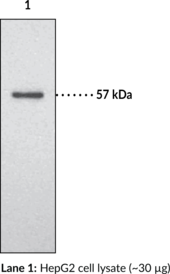
Technical Information
Synonyms
  • EL
  • EDL
Immunogen
Synthetic peptide from the N-terminal region of human endothelial lipase
500 µl of peptide affinity-purified polyclonal antibody
Storage Buffer
PBS, pH 7.2, with 50% glycerol, 0.5 mg/ml BSA, and 0.02% sodium azide
Host
Rabbit
Applications
IHC, WB
Species Reactivity
(+) Human(+) Mouse(+) Ovine(+) Porcine(+) Rat
UniProt Accession №
Q9Y5X9
Origin
Animal/Rabbit
Shipping & Storage Information
Storage
-20°C
Shipping
Wet ice in continental US; may vary elsewhere
Recommended Products

Certificates of Analysis & Batch Specific Data

Provide batch numbers separated by commas to download or request available product inserts, QC sheets, certificates of analysis, data packs, and GC-MS data.

    Add

    Cayman Chemical
    Explore Obesity & Metabolic Disease Resources

    Discover high-quality research tools to investigate GLP-1 mechanisms and next-generation metabolic targets.

    OBESITY RESEARCH SOLUTIONS
    Product Description

    Endothelial lipase (EL) is a major genetic determinant for the concentration, structure, and metabolism of high-density lipoprotein, which protects against atherosclerosis.1,2 It was originally cloned from endothelial cells and found to be expressed in a distinct and complementary tissue-restricted fashion, with high-level expression in the liver, placenta, lung, ovary, and macrophage.3 Immunohistochemical studies demonstrate that EL is expressed in infiltrating cells such as macrophages within atheromatous plaques, in addition to endothelial and smooth muscle cells in non-atherosclerotic coronary arteries. Furthermore, EL expression is detected in the neovasculature within atheromatous plaques in atherosclerotic coronary arteries, indicating that EL may have unique functional roles in atherosclerosis.4 Cayman Chemical’s EL polyclonal antibody can be used for western blot and immunohistochemical analysis for EL on samples of human, murine, rat, porcine, and ovine origin. Other applications for use of this antibody have not yet been tested.

    WARNING This product is not for human or veterinary use.

    References & Product Citations
    Product Description References

    1. Ishida, T., Choi, S., Kundu, R.K., et alEndothelial lipase is a major determinant of HDL level. J. Clin. Invest. 111(3), 347-355 (2003).

    2. Hirata, K.i., Dichek, H.L., Cioffi, J.A., et alCloning of a unique lipase from endothelial cells extends the lipase gene family. The Journal of Biological Chemisty 274(20), 14170-14175 (2003).

    3. Azumi, H., Hirata, K.i., Ishida, T., et alImmunohistochemical localization of endothelial cell-derived lipase in atherosclerotic human coronary arteries. Cardiovasc. Res. 58(3), 647-654 (2003).

    Product Citations

    Schneider, P., Bindila, L., Schmahl, C., et alAdverse social experiences in adolescent rats result in enduring effects on social competence, pain sensitivity and endocannabinoid signaling. Front. Behav. Neurosci. 10, (2016).

    Barrett, H.L., Kubala, M.H., Romero, K.S., et alPlacental lipases in pregnancies complicated by gestational diabetes mellitus (GDM). PLOS One 9(8), e104826 (2014).

    Jain, S., De Petris, L., Hoshi, M., et alExpression profiles of podocytes exposed to high glucose reveal new insights into early diabetic glomerulopathy. Lab. Invest. 91(4), 488-498 (2011).

