

Featured Tools for Obesity & Metabolic Disease Research
Reporter Assay Panel for Calcitonin and Amylin Receptors
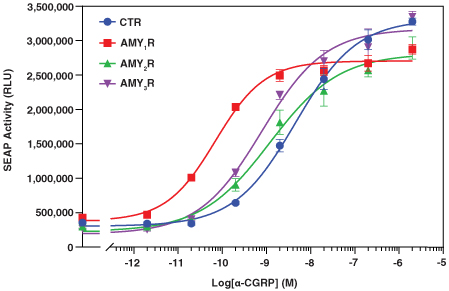
Investigate receptor selectivity and signaling with an easy-to-use, cell-based reporter assay panel designed for side-by-side analysis of CTR, AMY1R, AMY2R, and AMY3R.
Key Features
- High-throughput compatible
- Positive control α-CGRP included
TC4
Synthetic peptide and tetra-agonist of GLP-1R, GCGR, GIPR, and Y2 receptor.
LEARN MORERaptin (human, recombinant)
High-purity recombinant human protein for sleep-linked appetite and metabolic pathway research.
LEARN MOREBSA Metabolic Stress Reagent Set
BSA-fatty acid complexes with a paired control for cellular metabolic studies.
LEARN MOREReceptor Pharmacology
GLP-1 Receptor Agonists
Originally developed to treat type 2 diabetes, GLP-1 receptor agonists have found new therapeutic utility for obesity. GLP-1R is expressed in pancreatic beta cells, adipocytes, the brain, kidney, stomach, and heart. GLP-1 released from intestinal L-cells stimulates insulin biosynthesis, reduces glucagon secretion, and slows gastrointestinal motility to increase satiety. Cayman offers GLP-1R agonists for research use only.
VIEW ALL GLP-1R AGONISTSDual & Multi-Receptor Agonists
GLP-1 and GIP receptor agonists synergize, providing greater benefits than GLP-1 receptor agonists alone. These dual agonists, known as twincretins, also appear to reduce side effects through their complementary mechanisms of action. Glucagon receptor co-agonism further promotes satiety and increases energy expenditure through thermogenesis. Cayman offers a full range for research use only.
- Tirzepatide (sodium salt) · Dual GLP-1R/GIPR agonist
- Retatrutide (sodium salt) · Triple GLP-1R/GIPR/GCGR agonist
- Survodutide (trifluoroacetate salt) · Dual GLP-1R/GCGR agonist
- TC4 · Tetra GLP-1R/GCGR/GIPR/Y2R agonist
- Bamadutide · Dual GLP-1R/GCGR agonist
GLP-1, GIP, & GLP-2 Receptor Assays
Cayman offers cell-based reporter assay kits for functional characterization of GLP-1R, GIPR, and GLP-2R, enabling agonist potency determination, inhibitor screening, and comparative pharmacology across incretin and related receptor systems.
Calcitonin & Amylin Receptors
The calcitonin receptor (CTR) heterodimerizes with RAMP1, RAMP2, or RAMP3 to form the AMY1, AMY2, and AMY3 receptors, which regulate fat utilization, food intake, and glucose control. Amylin, co-secreted with insulin from pancreatic beta cells, induces satiety through homeostatic and hedonic regions of the brain via pathways complementary to GLP-1 with an additive effect on appetite reduction when combined. Cagrilintide, a long-acting amylin and calcitonin receptor agonist, is currently in phase 3 trials as CagriSema in combination with semaglutide.
DPP-IV Inhibitors & Assay
DPP-IV rapidly degrades incretins such as GLP-1, limiting their biological activity. DPP-IV inhibitors block this degradation, preserving native incretin bioactivity and enabling studies of endogenous GLP-1 physiology.
VIEW ALL DPP-IV INHIBITORSEndogenous Peptides & Hormones
GLP-1 Peptide Forms
GLP-1 is an incretin hormone released from the gut after eating. It stimulates insulin secretion, reduces post-meal blood glucose, slows gastric emptying, decreases gut motility, and reduces food intake and appetite. Cayman offers the endogenous GLP-1 peptides listed below, as well as a broader selection of exogenous GLP-1 peptides and analogs.
- GLP-1 (7-36) amide (human, bovine, guinea pig, mouse, rat) (trifluoro
acetate salt) - GLP-1 (1-36) amide (human, rat) (trifluoroacetate salt)
- GLP-1 (1-37) (human, rat, mouse, bovine) (trifluoro
acetate salt)

Peptide Hormones in Metabolism
Peptide hormones regulate energy metabolism, food intake, and satiety through distinct pathways. Raptin, a recently identified sleep-inducible hypothalamic hormone, suppresses appetite and gastric emptying through GRM3 signaling, extending the biology of body weight regulation beyond the gut.
- Amylin Peptides
- Ghrelin (human) (trifluoroacetate salt)
- Glucagon (hydrochloride)
- Raptin (human, recombinant)
Metabolic Signaling Assay Kits
Insulin Resistance & Glucose Homeostasis
Insulin and glucagon regulate blood glucose through opposing actions. Disruptions in glucose uptake and insulin signaling are central to the pathogenesis of type 2 diabetes and obesity.
- Glucose Uptake Cell-
Based Assay Kit - Glucose Colorimetric Assay Kit
- Glycogen Assay Kit
- Insulin (human) ELISA Kit
- Insulin (mouse, rat) EIA Kit
Lipid Metabolism & Adipose Biology
Obesity is associated with elevated triglycerides, excess adipose accumulation, impaired lipolysis, and hepatic steatosis, a predisposing condition for MASLD that is also directly relevant to glucagon receptor biology.
- Triglyceride Colorimetric Assay Kit
- Free Fatty Acid Fluorometric Assay Kit
- Adipolysis Assay Kit
- Glycerol Colorimetric Assay Kit
- Lipase Activity Assay Kit
- Cholesterol Fluorometric/Colorimetric Assay Kit
- Lipid Droplets Fluorescence Assay Kit
- Steatosis Colorimetric Assay Kit
- BSA Metabolic Stress Reagent Set (Palmitate and Oleate BSA Complexes)

PPAR Transcription Factor Assays
Peroxisome proliferator-activated receptors (PPARs) are nuclear transcription factors that function as master regulators of carbohydrate and lipid metabolism. PPARα regulates fatty acid oxidation in the liver; PPARγ controls adipogenesis and insulin sensitivity; PPARδ modulates energy expenditure and lipid catabolism in muscle and adipose tissue. PPAR dysregulation is directly implicated in insulin resistance, dyslipidemia, and hepatic steatosis in obesity. Cayman offers 96-well transcription factor assay kits for quantifying PPAR DNA binding activity across all three subtypes.
- PPARγ Transcription Factor Assay Kit
- PPARδ Transcription Factor Assay Kit
- PPARα Transcription Factor Assay Kit
- PPARα, δ, γ Complete Transcription Factor Assay Kit
Related Resources

Strategies and research tools for studying metabolic dysfunction in steatotic liver disease.
Read More
Visual reference covering lipid droplet structure, biogenesis, and metabolic function.
Learn More
Strategies and research tools for studying metabolic dysfunction in steatotic liver disease.
Read More
Cayman Services
Custom Assay Development
Tailored assay development and optimization for metabolic signaling, receptor biology, and functional readouts specific to your model.
Cellular Metabolism Services
Cell-based assessment of metabolic function, insulin resistance, lipid handling, and energy utilization.
Lipidomics & Lipid Analysis Services
Sensitive, specific lipid analysis using optimized LC-MS/MS methods and high-quality internal standards.
Sales
Reach out to our sales team for help with custom quantities & formulations, bulk requests, or general questions.
Subscribe to Our Emails
Stay up to date on the latest Endocrinology & Metabolism products, services, and resources from Cayman.