For immunochemical detection of LPA1
Related Products
Applicable for Use with
10006984LPA1 Blocking Peptide
Technical Support & Resources

Visit our FAQ

Contact Us

Toll Free Phone (USA and Canada Only): (888) 526-5351
Direct Phone: (734) 975-3888

Request Technical Support

Technical Support Request

To streamline the process attach the appropriate questionnaire to your inquiry.

Download IHC QuestionnaireDownload WB Questionnaire

View Our Privacy Statement for details on how we use and protect your data. In addition, this site is protected by hCaptcha and its Privacy Policy and Terms of Service apply.

LPA1 Polyclonal Antibody

Item No. 10005280

Technical Information
Synonyms
  • EDG-2
  • LPA Receptor 1
  • Lysophosphatidic Acid Receptor 1
Immunogen
Synthetic peptide from the C-terminal cytoplasmic region of human protein LPA1
500 µl of peptide affinity-purified polyclonal antibody
Storage Buffer
PBS, pH 7.2 with 50% glycerol and 0.02% sodium azide
Host
Rabbit
Applications
ICC, IF, IHC, and WB
Species Reactivity
(+) Human(+) Mouse(+) Rat
UniProt Accession №
Q92633
Origin
Animal/Rabbit
Shipping & Storage Information
Storage
-20°C
Shipping
Wet ice in continental US; may vary elsewhere
Recommended Products

Certificates of Analysis & Batch Specific Data

Provide batch numbers separated by commas to download or request available product inserts, QC sheets, certificates of analysis, data packs, and GC-MS data.

    Add

    Product Description

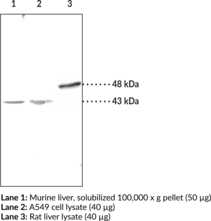
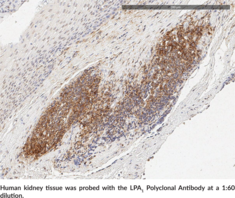
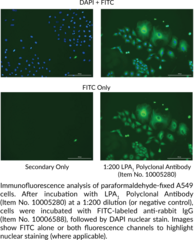
    LPA1 (also known as EDG-2) is one of four known LPA receptors (LPA1-4).1 LPA1-3 are part a family of G protein-coupled receptors that share identity to the sphingosine-1-phosphate receptors (S1P1-5).2 LPA1 couples with three types of G proteins, Gi/o, Gq, and G12/13 to induce a range of cellular responses including activation of phospholipase C, multiple kinases, the serum response element and cell proliferation.3,4 LPA1 mRNA is detected a wide range of tissues and cells including brain, heart, small intestine, spleen, testis, kidney, HeLa cells, and A549 cells.5,6 Mouse and human LPA1 have 364 amino acids with an estimated molecular weight of 41 kDa.4 Cayman’s LPA1 Polyclonal Antibody detects the protein from several species from 43-50 kDa, suggesting heterogeneous LPA1 post-translational modifications in distinct cells.

    WARNING This product is not for human or veterinary use.

    References & Product Citations
    Product Description References

    1. Noguchi, K., Ishii, S., and Shimizu, T. Identification of p2y9/GPR23 as a novel G protein-coupled receptor for lysophosphatidic acid, structurally distant from the Edg family. The Journal of Biological Chemisty 278(28), 25600-25606 (2003).

    2. Chun, J., Goetzl, E.J., Hla, T., et alInternational union of pharmacology. XXXIV. Lysophospholipid receptor nomenclature. Pharmacol. Rev. 54(2), 265-269 (2002).

    3. Fukushima, N., and Chun, J. The LPA receptors. Prostaglandins Other Lipid Mediat. 64, 21-32 (2001).

    4. Ishii, I., Fukushima, N., Ye, X., et alLysophospholipid receptors: Signaling and biology. Annu. Rev. Biochem. 73, 321-354 (2004).

    5. Contos, J.J.A., and Chun, J. The mouse lpA3/Edg7 lysophosphatidic acid receptor gene: genomic structure, chromosomal localization, and expression pattern. Gene 267, 243-253 (2001).

    6. An, S., Bleu, T., Hallmark, O.G., et alCharacterization of a novel subtype of human G protein-coupled receptor for lysophosphatidic acid. The Journal of Biological Chemisty 273(14), 7906-7910 (1998).

    Product Citations

    Sinderewicz, E., Grycmacher, K., Boruszewska, D., et alExpression of factors involved in apoptosis and cell survival is correlated with enzymes synthesizing lysophosphatidic acid and its receptors in granulosa cells originating from different types of bovine ovarian follicles. Reprod. Biol. Endocrinol. 15(1), 72 (2017).

    Suckau, O., Gross, I., Schrötter, S., et alLPA1, LPA2, LPA4, and LPA6 receptor expression during mouse brain development. Dev. Dyn. 248(5), 375-395 (2019).