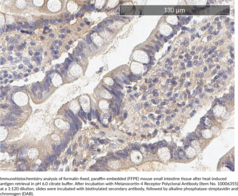
For immunochemical detection of MC4R
Technical Support & Resources

Visit our FAQ

Contact Us

Toll Free Phone (USA and Canada Only): (888) 526-5351
Direct Phone: (734) 975-3888

Request Technical Support

Technical Support Request

To streamline the process attach the appropriate questionnaire to your inquiry.

Download IHC QuestionnaireDownload WB Questionnaire

View Our Privacy Statement for details on how we use and protect your data. In addition, this site is protected by hCaptcha and its Privacy Policy and Terms of Service apply.

Melanocortin-4 Receptor Polyclonal Antibody

Item No. 10006355

Technical Information
Synonyms
  • MC4R
Immunogen
Synthetic peptide from the N-terminal region of mouse protein MC4R
500 µl of peptide affinity-purified polyclonal antibody
Storage Buffer
PBS, pH 7.2, with 50% glycerol and 0.02% sodium azide
Host
Rabbit
Applications
IHC (formalin-fixed paraffin-embedded sections) and WB
Species Reactivity
(+) Human(+) Mouse(+) Rat
UniProt Accession №
P56450
Origin
Animal/Rabbit
Shipping & Storage Information
Storage
-20°C
Shipping
Wet ice in continental US; may vary elsewhere
Recommended Products

Certificates of Analysis & Batch Specific Data

Provide batch numbers separated by commas to download or request available product inserts, QC sheets, certificates of analysis, data packs, and GC-MS data.

    Add

    Cayman Chemical
    Explore Obesity & Metabolic Disease Resources

    Discover high-quality research tools to investigate GLP-1 mechanisms and next-generation metabolic targets.

    OBESITY RESEARCH SOLUTIONS
    Product Description

    Melanocortins are known to exert a broad array of physiological actions including 'melanogenesis, steroidogenesis, sexual function and inflammation, as well as appetite regulation and energy homeostasis'.1 These actions are mediated (differentially or concurrently) in part by a family of G protein-coupled receptors, the melanocortin receptors 1-5 (MC1R-MC5R). Melanocortin-4 receptor (MC4R) was first cloned in 1993 with transcripts expressed primarily in the brain.2 Genetic studies of mice and humans have established a critical role of MC4R in appetite regulation.3 Heterozygous mutations in MC4R account for 1-6% of severe cases of human obesity. Thus, MC4R has been a prime target for therapeutic intervention in obesity.4 All known mammalian MC4Rs are 332 amino acids in length with an estimated molecular weight of 37 kDa. The protein is heavily glycosylated and appears at multiple positions on SDS-PAGE.5 Cayman’s MC4R Polyclonal Antibody mainly detects an unglycosylated protein at 37 kDa and a glycosylated protein at 55 kDa.

    WARNING This product is not for human or veterinary use.

    References & Product Citations
    Product Description References

    1. Yeo, G.S.H., and Siddle, K. Attractin' more attention-new pieces in the obesity puzzle? Biochem. J. 376, e7-e8 (2003).

    2. Gantz, I., Miwa, H., Konda, Y., et alMolecular cloning, expression, and gene localization of a fourth melanocortin receptor. The Journal of Biological Chemisty 268(20), 15174-15179 (1993).

    3. Fan, W., Boston, B.A., Kesterson, R.A., et alRole of melanocortinergic neurons in feeding and the agouti obesity syndrome. Nature 385, 165-168 (1997).

    4. Crowley, V.E.F., Yeo, G.S.H., and O'Rahilly, S. Obesity therapy: Altering the energy intake-and-expenditure balance sheet. Nat. Rev. Drug Discov. 1(4), 276-286 (2002).

    5. Ho, G., and MacKenzie, R.G. Functional characterization of mutations in melanocortin-4 receptor associated with human obesity. The Journal of Biological Chemisty 274(50), 35816-35822 (1999).