For immunochemical detection of ATGL
Technical Support & Resources

Visit our FAQ

Contact Us

Toll Free Phone (USA and Canada Only): (888) 526-5351
Direct Phone: (734) 975-3888

Request Technical Support

Technical Support Request

To streamline the process attach the appropriate questionnaire to your inquiry.

Download IHC QuestionnaireDownload WB Questionnaire

View Our Privacy Statement for details on how we use and protect your data. In addition, this site is protected by hCaptcha and its Privacy Policy and Terms of Service apply.

Adipose Triglyceride Lipase Polyclonal Antibody

Item No. 10006409

Technical Information
Synonyms
  • ATGL
  • Calcium-independent Phospholipase A2
  • Desnutrin
  • IPLA2-ζ
  • Patatin-like Phospholipase Domain-containing Protein 2
  • Phospholipase A2ζ
  • Pigment Epithelium-derived Factor
  • PNPLA2
  • TTS2.2
Immunogen
Synthetic peptide from an internal region of human ATGL
500 μl of peptide affinity-purified polyclonal antibody
Storage Buffer
PBS, pH 7.2, with 50% glycerol and 0.02% sodium azide
Host
Rabbit
Applications
IHC (paraffin-embedded tissue) and WB
Species Reactivity
(+) Human(+) Mouse(+) Rat
UniProt Accession №
Q96AD5
Origin
Animal/Rabbit
Shipping & Storage Information
Storage
-20°C
Shipping
Wet ice in continental US; may vary elsewhere
Recommended Products

Certificates of Analysis & Batch Specific Data

Provide batch numbers separated by commas to download or request available product inserts, QC sheets, certificates of analysis, data packs, and GC-MS data.

    Add

    Cayman Chemical
    Explore Obesity & Metabolic Disease Resources

    Discover high-quality research tools to investigate GLP-1 mechanisms and next-generation metabolic targets.

    OBESITY RESEARCH SOLUTIONS
    Product Description

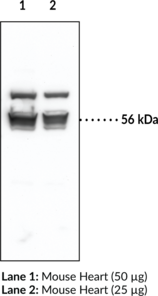
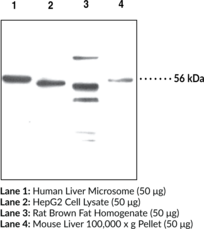
    Triglycerides are the most efficient form of energy storage in mammalian adipose tissue during times of caloric excess. ATGL is one of the key enzymes involved in the mobilization of fatty acids from triglyceride stores in adipose tissue, catalyzing the conversion of triacylglycerols to diacylglycerols.1 Inhibition of ATGL markedly decreases total adipose acyl-hydrolase activity, and thus may be a potential drug target for the diabetic pathology.1 ATGL mRNA is detected in a wide range of tissues including adipose, lung, skeletal muscle, testis, heart, brain, and kidney, with adipose tissue expressing the highest level.2 Human ATGL is 504 amino acids in length with an estimated molecular weight of 55.2 kDa. Cayman’s ATGL Polyclonal Antibody detects the enzyme at 56 kDa by Western blot from tissues and cells such as brown fat, liver, mouse macrophages, and HepG2 cells.

    WARNING This product is not for human or veterinary use.

    References & Product Citations
    Product Description References

    1. Zimmermann, R., Strauss, J.G., Haemmerle, G., et alFat mobilization in adipose tissue is promoted by adipose triglyceride lipase. Science 306(5700), 1383-1386 (2004).

    2. Villena, J.A., Roy, S., Sarkadi-Nagy, E., et alDesnutrin, an adipocyte gene encoding a novel patatin domain-containing protein, is induced by fasting and glucocorticoids. Ectopic expression of desnutrin increases triglyceride hydrolysis. The Journal of Biological Chemisty 279(45), 47066-47075 (2004).

    Product Citations

    Wu, J.W., Preuss, C., Wang, S.P., et alEpistatic interaction between the lipase-encoding genes Pnpla2 and Lipe causes liposarcoma in mice. PLoS Genet. 13(5), e1006716 (2017).

    Das, S.K., Stadelmeyer, E., Schauer, S., et alMicro RNA-124a regulates lipolysis via adipose triglyceride lipase and comparative gene identification 58. Int. J. Mol. Sci. 16, 8555-8568 (2015).