
Technical Support & Resources
Visit our FAQ
Contact Us
Toll Free Phone (USA and Canada Only): (888) 526-5351
Direct Phone: (734) 975-3888
Product Categories
Application
Prostaglandin D Synthase (hematopoietic-type; human, recombinant)
Item No. 10006593
Technical Information
- H-PGDS
- hH-PGDS
- Hematopoietic-PGDS
- PGD Synthase (hematopoietic-type; human recombinant)
Shipping & Storage Information
Recommended Products
Certificates of Analysis & Batch Specific Data
Provide batch numbers separated by commas to download or request available product inserts, QC sheets, certificates of analysis, data packs, and GC-MS data.
Lipid Resource Center
Discover Products & Resources for Lipid Research
- High-purity lipid standards
- Lipid roles in biology
- Lipids in health & disease
- Lipids for pharmaceutical development
- Protocols, advice, & resources
Product Description
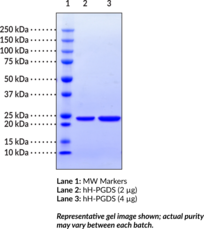
Prostaglandin D synthase (PGDS) is a glutathione-dependent enzyme and member of the sigma class of glutathione-S-transferases (GSTs) that catalyzes the conversion of PGH2 (Item No. 17020) to PGD2 (Item No. 12010), an eicosanoid that has numerous biological functions, including vasorelaxation, recruitment of inflammatory cells, and inhibition of platelet aggregation.1,2,3 There are two types of PGDS: lipocalin PGDS (L-PGDS; Item No. 10006788) and hematopoietic PGDS (H-PGDS; Item No. 10006593).3 H-PGDS is found in peripheral tissues and immune cells, including Th2 cells, antigen-presenting cells, mast cells, megakaryocytes, and eosinophils, where it is localized to the cytosol.2 H-PGDS activity is increased by a variety of stimuli, including LPS, anti-IgE antibodies, phorbol 12-myristate 13-acetate (TPA; Item No. 10008014), ionomycin (Item No. 10004974), and inflammatory cytokines such as IL-13, IL-3, or IL-4.3 siRNA silencing of Hpgds decreases LPS-induced production of PGD2 in mouse bone marrow-derived macrophages (BMDMs).4 Transgenic overexpression of HPGDS in mice increases croton oil-induced ear swelling and PGD2 production, and genome-wide deletion of Hpgds exacerbates hypotension and vascular permeability in a mouse model of anaphylaxis.5,6 H-PGDS protein levels are increased in the nasal mucosa of patients with allergic rhinitis, and HPGDS SNPs have been found in individuals with asthma.3,1 Cayman's Prostaglandin D Synthase (hematopoietic-type; human, recombinant) can be used for enzyme activity assays.
WARNING This product is not for human or veterinary use.
References & Product Citations
1. Hematopoietic prostaglandin D synthase. Prostaglandins Leukot. Essent. Fatty Acids 69(2-3), 163-167 (2003).
2. Hematopoietic prostaglandin D synthase inhibitors. Prog. Med. Chem. 51, 97-133 (2012).
3. Therapeutic potential of hematopoietic prostaglandin D2 synthase in allergic inflammation. Cells 8(6), 619 (2019).
4. Pivotal role of reactive oxygen species in differential regulation of lipopolysaccharide-
5. Opposing immunomodulatory roles of prostaglandin D2 during the progression of skin inflammation. J. Immunol. 192(1), 459-465 (2014).
6. Mast cell-
Selective inhibition of prostaglandin D2 biosynthesis in human mast cells to overcome need for multiple receptor antagonists: Biochemical consequences. Clin. Exp. Allergy 51(4), 594-603 (2021).
Contact Info
Cayman Chemical1180 East Ellsworth RoadAnn Arbor, Michigan 48108 USAToll Free: (800) 364-9897(USA and Canada only)Fax: (734) 971-3640


