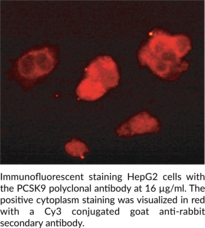
For immunochemical detection of PCSK9
Technical Support & Resources

Visit our FAQ

Contact Us

Toll Free Phone (USA and Canada Only): (888) 526-5351
Direct Phone: (734) 975-3888

Request Technical Support

Technical Support Request

To streamline the process attach the appropriate questionnaire to your inquiry.

Download IHC QuestionnaireDownload WB Questionnaire

View Our Privacy Statement for details on how we use and protect your data. In addition, this site is protected by hCaptcha and its Privacy Policy and Terms of Service apply.

PCSK9 (human) Polyclonal Antibody

Item No. 10007185

Technical Information
Synonyms
  • NARC-1
  • Proprotein Convertase Subtilisin Kexin 9
Immunogen
Synthetic peptide from an internal region of human PCSK9
500 μl of peptide affinity-purified polyclonal antibody
Storage Buffer
PBS, pH 7.2, with 50% glycerol and 0.02% sodium azide
Host
Rabbit
Applications
IF and WB
Species Reactivity
(+) Human(+) Mouse(+) Rat
UniProt Accession №
Q8NBP7
Origin
Animal/Rabbit
Shipping & Storage Information
Storage
-20°C
Shipping
Wet ice in continental US; may vary elsewhere
Recommended Products

Certificates of Analysis & Batch Specific Data

Provide batch numbers separated by commas to download or request available product inserts, QC sheets, certificates of analysis, data packs, and GC-MS data.

    Add

    Cayman Chemical
    Explore Obesity & Metabolic Disease Resources

    Discover high-quality research tools to investigate GLP-1 mechanisms and next-generation metabolic targets.

    OBESITY RESEARCH SOLUTIONS
    Product Description

    Proprotein convertase subtilisin kexin 9 (PCSK9) is a member of the subtilisin serine protease family with an important role in lipoprotein metabolism.1 Mutation in the PCSK9 gene is associated with autosomal dominant hypercholesterolemia which is characterized by an increase in low density lipoprotein (LDL) cholesterol levels.2 PCSK9 overexpression in wild-type mice doubles the plasma total cholesterol, possibly through acceleration of the degradation of the LDL receptor.3,1 PCSK9 mRNA is detected in various tissues such as liver, kidney, lung, spleen, jejunum, ileum, colon, and muscle with the highest expression in the liver.4 Human PCSK9 precursor is 692 amino acids in length with an estimated molecular weight of 74 kDa. This proprotein is self-cleaved to form a mature protein at around 63 kDa in the golgi.5 Cayman’s PCSK9 polyclonal antibody detects mainly the mature form of the protein ranging from 62-66 kDa in tissues and cells such as liver, kidney, and colon cancer cells.

    WARNING This product is not for human or veterinary use.

    References & Product Citations
    Product Description References

    1. Maxwell, K.N., Fisher, E.A., and Breslow, J.L. Overexpression of PCSK9 accelerates the degradation of the LDLR in a post-endoplasmic reticulum compartment. Proc. Natl. Acad. Sci. USA 102(6), 2069-2074 (2005).

    2. Abifadel, M., Varret, M., Rabès, J.P., et alMutations in PCSK9 cause autosomal dominant hypercholesterolemia. Nat. Genet. 34(2), 154-156 (2003).

    3. Maxwell, K.N., and Breslow, J.L. Adenoviral-mediated expression of Pcsk9 in mice results in a low-density lipoprotein receptor knockout phenotype. Proc. Natl. Acad. Sci. USA 101(18), 7100-7105 (2004).

    4. Seidah, N.G., Benjannet, S., Wickham, L., et alThe secretory proprotein convertase neural apoptosis-regulated convertase 1 (NARC-1): Liver regeneration and neuronal differentiation. Proc. Natl. Acad. Sci. USA 100(3), 928-933 (2003).

    5. Maxwell, K.N., and Breslow, J.L. Proprotein convertase subtilisin kexin 9: The third locus implicated in autosomal dominant hypercholesterolemia. Curr. Opin. Lipidol. 16(2), 167-172 (2005).

    Product Citations

    Benjannet, S., Rhainds, D., Hamelin, J., et alThe proprotein convertase (PC) PCSK9 is inactivated by furin and/or PC5/6A. Functional consequences of natural mutations and post-translational modifications. The Journal of Biological Chemisty 281(41), 30561-30572 (2006).