
Features
- Purpose built for quantitative mass spectrometry
- Prepared gravimetrically as a solution with a defined concentration
- Packaged in an ampule sealed under argon to maintain product integrity
- Guaranteed to meet MaxSpec® identity, purity, stability, and concentration specifications
Technical Support & Resources
Visit our FAQ
Contact Us
Toll Free Phone (USA and Canada Only): (888) 526-5351
Direct Phone: (734) 975-3888
Product Categories
Application

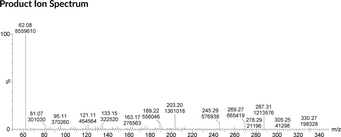
Technical Information
- AEA
- Anandamide
Shipping & Storage Information
Recommended Products
Certificates of Analysis & Batch Specific Data
Provide batch numbers separated by commas to download or request available product inserts, QC sheets, certificates of analysis, data packs, and GC-MS data.
Lipid Resource Center
Discover Products & Resources for Lipid Research
- High-purity lipid standards
- Lipid roles in biology
- Lipids in health & disease
- Lipids for pharmaceutical development
- Protocols, advice, & resources
Product Description
Arachidonoyl ethanolamide (AEA) is the ethanolamine amide of arachidonic acid (Item No. 90010), first isolated from porcine brain.1 AEA is an endogenous cannabinoid neurotransmitter that binds to both central cannabinoid (CB1) and peripheral cannabinoid (CB2) receptors.2 AEA inhibits the specific binding of [3H]-
AEA MaxSpec® standard is a quantitative grade standard of AEA (Item No. 90050) that has been prepared specifically for mass spectrometry or any application where quantitative reproducibility is required. The solution has been prepared gravimetrically and is supplied in a deactivated glass ampule sealed under argon. The concentration was verified by comparison to an independently prepared calibration standard. The verified concentration is provided on the certificate of analysis. This AEA MaxSpec® standard is guaranteed to meet identity, purity, stability, and concentration specifications and is provided with a batch-specific certificate of analysis. Ongoing stability testing is performed to ensure the concentration remains accurate throughout the shelf life of the product. Note: The amount of solution added to the vial is in excess of the listed amount. Therefore, it is necessary to accurately measure volumes for preparation of calibration standards. Follow recommended storage and handling conditions to maintain product quality.
WARNING This product is not for human or veterinary use.
References & Product Citations
1. Isolation and structure of a brain constituent that binds to the cannabinoid receptor. Science 258(5090), 1946-1949 (1992).
2. Anandamide, an endogenous cannabimimetic eicosanoid, binds to the cloned human cannabinoid receptor and stimulates receptor-
Contact Info
Cayman Chemical1180 East Ellsworth RoadAnn Arbor, Michigan 48108 USAToll Free: (800) 364-9897(USA and Canada only)Fax: (734) 971-3640


