
Technical Support & Resources
Information provided in the product description is from published literature. Due to the nature of scientific experimentation, your results (e.g., selectivity and effective concentrations) or specific application for this product may differ. If you have questions about how this product fits your application, please contact our technical support staff.
Visit our FAQ
Contact Us
Toll Free Phone (USA and Canada Only): (888) 526-5351
Direct Phone: (734) 975-3888
Technical Information
- AEA
- Anandamide
Shipping & Storage Information
Recommended Products


Certificates of Analysis & Batch Specific Data
Provide batch numbers separated by commas to download or request available product inserts, QC sheets, certificates of analysis, data packs, and GC-MS data.
Lipid Resource Center
Discover Products & Resources for Lipid Research
- High-purity lipid standards
- Lipid roles in biology
- Lipids in health & disease
- Lipids for pharmaceutical development
- Protocols, advice, & resources
Product Description
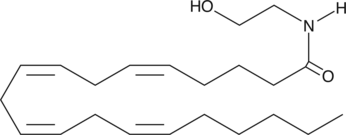
Arachidonoyl ethanolamide (AEA) is the ethanolamine amide of arachidonic acid, originally isolated from porcine brain.1 AEA is an endogenous cannabinoid neurotransmitter that binds to both cannabinoid 1 (CB1) and CB2 receptors.2 AEA has Ki values ranging from 61 to 543 nM for CB1 receptors and from 279 to 1,940 nM for CB2 receptors.3
WARNING This product is not for human or veterinary use.
References & Product Citations
1. Isolation and structure of a brain constituent that binds to the cannabinoid receptor. Science 258(5090), 1946-1949 (1992).
2. Anandamide, an endogenous cannabimimetic eicosanoid, binds to the cloned human cannabinoid receptor and stimulates receptor-
3. Pharmacology of cannabinoid receptor ligands. Curr. Med. Chem. 6(8), 635-664 (1999).
Quantitative profiling of inflammatory and pro-
In vitro determination of the CB1 efficacy of illicit synthetic cannabinoids. (2019).
Cannabinoid-
Comparison of eight 15-
Quantitative profiling of endocannabinoids and related N-
Omega-
Characterisation of (R)-
Inhibition of endocannabinoid metabolism by the metabolites of ibuprofen and flurbiprofen. PLoS One 9(7), e103589 (2014).
Involvement of ERK1/2, cPLA2 and NF-
Expression and function of fatty acid amide hydrolase in protstate cancer. Int. J. Cancer 123(6), 1318-1326 (2008).
PSNCBAM-
Anandamide amidohydrolase reacting with 2-
Enzymatic synthesis and degradation of anandamide, a cannabinoid receptor agonist. Biochem. Pharmacol. 46, 791-796 (1993).
Contact Info
Cayman Chemical1180 East Ellsworth RoadAnn Arbor, Michigan 48108 USAToll Free: (800) 364-9897(USA and Canada only)Fax: (734) 971-3640


