Full-length receptor in high-purity form
Technical Support & Resources

Visit our FAQ

Contact Us

Toll Free Phone (USA and Canada Only): (888) 526-5351
Direct Phone: (734) 975-3888

Request Technical Support

Technical Support Request

To streamline the process attach the appropriate questionnaire to your inquiry.

Download IHC QuestionnaireDownload WB Questionnaire

View Our Privacy Statement for details on how we use and protect your data. In addition, this site is protected by hCaptcha and its Privacy Policy and Terms of Service apply.

PPARδ (human, recombinant)

Item No. 10007451

Technical Information
Synonyms
  • FAAR
  • NUC1
  • Nuclear Hormone Receptor 1
  • Peroxisome Proliferative Activated Receptor δ
  • PPARβ
Purity
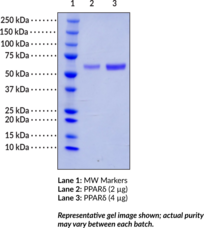
≥95% estimated by SDS-PAGE
Source
Recombinant protein isolated from baculovirus overexpression system in Sf21 cells
Amino Acids
2-441 (full length)
MW
54 kDa
A solution in 50 mM of sodium phosphate, pH 7.2, containing 20% glycerol, 100 mM sodium chloride, and 1 mM DTT
Shipping & Storage Information
Storage
-80°C
Shipping
Dry ice in continental US; may vary elsewhere
Recommended Products

Certificates of Analysis & Batch Specific Data

Provide batch numbers separated by commas to download or request available product inserts, QC sheets, certificates of analysis, data packs, and GC-MS data.

    Add

    Add

    Cayman Chemical
    Explore Obesity & Metabolic Disease Resources

    Discover high-quality research tools to investigate GLP-1 mechanisms and next-generation metabolic targets.

    OBESITY RESEARCH SOLUTIONS
    Product Description

    Peroxisome proliferator-activated receptors (PPARs) are members of the nuclear receptor family of ligand activated transcription factors that heterodimerize with retinoic acid like receptors, regulating gene expression and differentiation.1 The PPAR family of nuclear hormone receptors consists of three subtypes encoded by separate genes: PPARα, PPARδ (also referred to as hNUC1, PPARβ, or FAAR), and PPARγ. PPARδ is ubiquitously expressed but is particularly abundant in tissues such as liver, intestine, kidney, abdominal adipose, and skeletal muscle, all of which are involved in lipid metabolism.2 PPARδ is a mediator of diverse physiological functions including lipid and cholesterol homeostasis, embryo implantation, and cancer development.3,4,5,6 Most recently, attention has been focused on the role of PPARδ in obesity.7 Cayman’s PPARδ protein is purified from a baculovirus overexpression system. The purity was determined using gel electrophoresis followed by coomassie staining.

    WARNING This product is not for human or veterinary use.

    References & Product Citations
    Product Description References

    1. Kersten, S., Desvergne, B., and Wahli, W. Roles of PPARs in health and disease. Nature 405(6785), 421-424 (2000).

    2. Willson, T.M., Brown, P.J., Sternbach, D.D., et alThe PPARs: From orphan receptors to drug discovery. J. Med. Chem. 43(4), 527-550 (2000).

    3. Amri, E.Z., Bonino, F., Ailhaud, G., et alCloning of a protein that mediates transcriptional effects of fatty acids in preadipocytes. Homology to peroxisome proliferator-activated receptors. The Journal of Biological Chemisty 270, 2367-2371 (1995).

    4. Berger, J., Leibowitz, M.D., Doebber, T.W., et alNovel peroxisome proliferator-activated receptor (PPAR) γ and PPARδ ligands produce distinct biological effects. The Journal of Biological Chemisty 574(10), 6718-6725 (1999).

    5. Lim, H., and Dey, S.K. PPARδ functions as a prostacyclin receptor in blastocyst implantation. Trends Endocrinol. Metab. 11(4), 137-142 (2000).

    6. He, T.-C., Chan, T.A., Vogelstein, B., et alPPARδ is an APC-regulated target of nonsteroidal anti-inflammatory drugs. Cell 99(3), 335-345 (1999).

    7. Wang, Y.-X., Lee, C.-H., Tiep, S., et alPeroxisome-proliferator-activated receptor δ activates fat metabolism to prevent obesity. Cell 113(2), 159-170 (2003).