For immunochemical detection of SREBP-2
Related Products
Technical Support & Resources

Visit our FAQ

Contact Us

Toll Free Phone (USA and Canada Only): (888) 526-5351
Direct Phone: (734) 975-3888

Request Technical Support

Technical Support Request

To streamline the process attach the appropriate questionnaire to your inquiry.

Download IHC QuestionnaireDownload WB Questionnaire

View Our Privacy Statement for details on how we use and protect your data. In addition, this site is protected by hCaptcha and its Privacy Policy and Terms of Service apply.

SREBP-2 Polyclonal Antibody

Item No. 10007663

Technical Information
Synonyms
  • SREBF2
  • Sterol Regulatory Element-binding Protein-2
  • Sterol Regulatory Element-binding Transcription Factor 2
Immunogen
Synthetic peptide from an internal region of human SREBP-2
500 μl of peptide-affinity purified polyclonal antibody
Storage Buffer
PBS, pH 7.2, with 50% glycerol and 0.02% sodium azide
Host
Rabbit
Applications
IF, IHC, and WB
Species Reactivity
(+) Human(+) Mouse(+) Rat
UniProt Accession №
Q12772
Origin
Animal/Rabbit
Shipping & Storage Information
Storage
-20°C
Shipping
Wet ice in continental US; may vary elsewhere
Recommended Products

Certificates of Analysis & Batch Specific Data

Provide batch numbers separated by commas to download or request available product inserts, QC sheets, certificates of analysis, data packs, and GC-MS data.

    Add

    Product Description

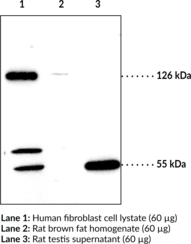
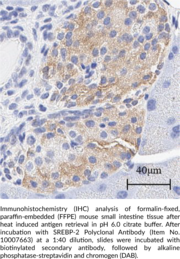
    SREBPs, including SREBP-1a, SREBP-1c, and SREBP-2, constitute a family of basic helix-loop-helix (bHLH) transcription factors that play a critical role in lipid homeostasis by regulating genes involved in cholesterol and fatty acid metabolism.1 SREBP-2 regulates cholesterol synthesis by activating the transcription of genes for HMG-CoA reductase and other enzymes of the cholesterol synthetic pathway.2 SREBP-2 is ubiquitously detected in various tissues.3 Upon cholesterol depletion, the protein is cleaved to its active forms (about 50-68 kDa) and translocated into the nucleus to stimulate transcription of genes involved in the uptake and synthesis of cholesterol.4 Cayman’s SREBP-2 polyclonal antibody detects both precursor and active forms of the protein in tissues and cells such as liver, brown fat, testis, HepG2 cells, and human fibroblast. The apparent molecular weight on SDS-PAGE may be higher than the calculated molecular weight (about 126 kDa) due to glycosylation of the protein.5

    WARNING This product is not for human or veterinary use.

    References & Product Citations
    Product Description References

    1. Brown, M.S., and Goldstein, J.L. The SREBP pathway: Regulation of cholesterol metabolism by proteolysis of a membrane-bound transcription factor. Cell 89(3), 331-340 (1997).

    2. Sakai, J., Nohturfft, A., Goldstein, J.L., et alCleavage of sterol regulatory element-binding proteins (SREBPs) at site-1 requires interaction with SREBP cleavage-activating protein. Evidence from in vivo competition studies. The Journal of Biological Chemisty 273(10), 5785-5793 (1998).

    3. Iizuka, K., Bruick, R.K., Liang, G., et alDeficiency of carbohydrate response element-binding protein (ChREBP) reduces lipogenesis as well as glycolysis. Proc. Natl. Acad. Sci. USA 101(19), 7281-7286 (2004).

    4. Smith, L.H., Petrie, M.S., Morrow, J.D., et alThe sterol response element binding protein regulates cyclooxygenase-2 gene expression in endothelial cells. J. Lipid Res. 46, 862-871 (2005).

    5. Hua, X., Sakai, J., Ho, Y.K., et alHairpin orientation of sterol regulatory element-binding protein-2 in cell membranes as determined by protease protection. The Journal of Biological Chemisty 270(49), 29422-29427 (1995).

    Product Citations

    Mahmud, I., Tian, G., Wang, J., et alDAXX drives de novo lipogenesis and contributes to tumorigenesis. Nat. Commun. 14(1), 1927 (2023).