
Technical Support & Resources
Visit our FAQ
Contact Us
Toll Free Phone (USA and Canada Only): (888) 526-5351
Direct Phone: (734) 975-3888
Product Categories
SREBP-2 Monoclonal Antibody (Clone 1B7)
Item No. 27231
Technical Information
- SREBF2
- Sterol Regulatory Element-binding Protein-2
- Sterol Regulatory Element-binding Transcription Factor 2
Shipping & Storage Information
Recommended Products
Certificates of Analysis & Batch Specific Data
Provide batch numbers separated by commas to download or request available product inserts, QC sheets, certificates of analysis, data packs, and GC-MS data.
Lipid Resource Center
Discover Products & Resources for Lipid Research
- High-purity lipid standards
- Lipid roles in biology
- Lipids in health & disease
- Lipids for pharmaceutical development
- Protocols, advice, & resources
Product Description
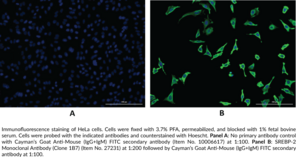
Sterol regulatory element-binding protein-2 (SREBP-2) is a membrane-bound transcription factor encoded by the SREBF2 gene in humans and is involved in the regulation of cholesterol biosynthesis and uptake.1,2,3 Similar to SREBP-1a and SREBP-1c, SREBP-2 is comprised of an N-terminal acidic domain, a basic-helix-loop-helix leucine zipper (bHLH-Zip) sequence, two transmembrane segments, and a regulatory C-terminal domain.1 In the absence of sterols, SREBP-2 undergoes two sequential proteolytic cleavage events resulting in release of the bHLH-Zip-containing N terminus from the endoplasmic reticulum membrane, followed by translocation to the nucleus.1,2 Nuclear SREBP-2 (nSREBP-2) binds to sterol response elements (SREs) in DNA and regulates expression of genes encoding HMG-CoA synthase, HMG-CoA reductase, farnesyl diphosphate synthase, and squalene synthase, among others.2 Srebp2 is ubiquitously expressed in mouse tissues and knockout of Srebp2 is embryonic lethal in mice.4,2 Hepatic expression of SREBF2 is seven- and three-fold higher in patients with non-alcoholic steatohepatitis (NASH) and steatosis, respectively, than that of healthy individuals.5 Cayman's SREBP-2 Monoclonal Antibody (Clone 1B7) can be used for immunocytochemistry, immunohistochemistry, and western blot applications.
WARNING This product is not for human or veterinary use.
References & Product Citations
1. The SREBP pathway: Regulation of cholesterol metabolism by proteolysis of a membrane-
2. SREBPs: Activators of the complete program of cholesterol and fatty acid synthesis in the liver. J. Clin. Invest. 109(9), 1125-1131 (2002).
3. SREBP transcription factors: Master regulators of lipid homeostasis. Biochimie 86(11), 839-848 (2004).
4. Deficiency of carbohydrate response element-
5. Enhanced free cholesterol, SREBP-
Contact Info
Cayman Chemical1180 East Ellsworth RoadAnn Arbor, Michigan 48108 USAToll Free: (800) 364-9897(USA and Canada only)Fax: (734) 971-3640


