
Technical Support & Resources
Information provided in the product description is from published literature. Due to the nature of scientific experimentation, your results (e.g., selectivity and effective concentrations) or specific application for this product may differ. If you have questions about how this product fits your application, please contact our technical support staff.
Visit our FAQ
Contact Us
Toll Free Phone (USA and Canada Only): (888) 526-5351
Direct Phone: (734) 975-3888
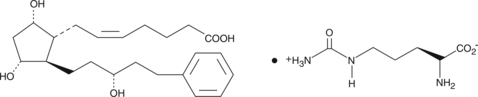
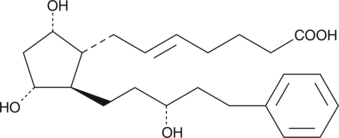
Latanoprost (free acid) (L-arginine salt)
Item No. 10008432
Technical Information
- PhXA-85
- 17-phenyl-13,14-dihydro trinor Prostaglandin F2α
Shipping & Storage Information
Recommended Products

Certificates of Analysis & Batch Specific Data
Provide batch numbers separated by commas to download or request available product inserts, QC sheets, certificates of analysis, data packs, and GC-MS data.
Lipid Resource Center
Discover Products & Resources for Lipid Research
- High-purity lipid standards
- Lipid roles in biology
- Lipids in health & disease
- Lipids for pharmaceutical development
- Protocols, advice, & resources
Product Description
Latanoprost (free acid) (L-arginine salt) is a salt form of latanoprost (free acid) (Item No. 16811) that results in a crystalline solid.1 This solid form of latanoprost improves ease of handling, making it ideal for use as a synthetic intermediate and for compounding it into mixtures with other components. Latanoprost (free acid) is a derivative of prostaglandin F2α (PGF2α; Item Nos. 16010 | 16020), an FP receptor agonist, and an active metabolite of the prodrug latanoprost (Item No. 16812).2 It selectively binds to the FP receptor (Ki = 0.098 µM) over the EP1, EP1, EP3, and EP4 receptors (Kis = 2.06, 39.667, 7.519, and 75 µM, respectively), as well as the DP, IP, and TP receptors (Kis = ≥20, ≥90, and ≥60 µM, respectively). It induces phosphoinositide turnover in isolated human ciliary muscle and human trabecular meshwork cells, mouse NIH3T3 fibroblasts, and rat A7r5 vascular smooth muscle cells, which all endogenously express FP receptors (EC50s = 124, 35, 32, and 35 nM, respectively), as well as HEK293 cells expressing human ocular FP receptors (EC50 = 45.7 nM). It also increases intracellular calcium levels in hEP1-5/293-AEQ17 cells expressing EP1 receptors in an aequorin-based calcium assay (EC50 = 119 nM).3 Latanoprost (free acid) induces contraction of isolated cat iris sphincter smooth muscle (EC50 = 29.9 nM).4
WARNING This product is not for human or veterinary use.
References & Product Citations
1. Amino acid salts of prostaglandins. (2009).
2. Ocular hypotensive FP prostaglandin (PG) analogs: PG receptor subtype binding affinities and selectivities, and agonist potencies at FP and other PG receptors in cultured cells. J. Ocul. Pharmacol. Ther. 19(6), 501-515 (2003).
3. Key structural features of prostaglandin E2 and prostanoid analogs involved in binding and activation of the human EP1 prostanoid receptor. Mol. Pharmacol. 59(6), 1446-1456 (2001).
4. Cat iris sphincter smooth-
Contact Info
Cayman Chemical1180 East Ellsworth RoadAnn Arbor, Michigan 48108 USAToll Free: (800) 364-9897(USA and Canada only)Fax: (734) 971-3640


