For immunochemical detection of ApoA1
Technical Support & Resources

Visit our FAQ

Contact Us

Toll Free Phone (USA and Canada Only): (888) 526-5351
Direct Phone: (734) 975-3888

Request Technical Support

Technical Support Request

To streamline the process attach the appropriate questionnaire to your inquiry.

Download IHC QuestionnaireDownload WB Questionnaire

View Our Privacy Statement for details on how we use and protect your data. In addition, this site is protected by hCaptcha and its Privacy Policy and Terms of Service apply.

ApoA1 Polyclonal Antibody

Item No. 10008463

Technical Information
Synonyms
  • Apolipoprotein A1
Immunogen
Synthetic peptide from an internal region of human ApoA1
500 μl of peptide affinity-purified polyclonal antibody
Storage Buffer
PBS, pH 7.2, with 50% glycerol and 0.02% sodium azide
Host
Rabbit
Applications
IF, IHC, and WB
Species Reactivity
(+) Human(+) Mouse(+) Rat
UniProt Accession №
P02647
Origin
Animal/Rabbit
Shipping & Storage Information
Storage
-20°C
Shipping
Wet ice in continental US; may vary elsewhere
Recommended Products

Certificates of Analysis & Batch Specific Data

Provide batch numbers separated by commas to download or request available product inserts, QC sheets, certificates of analysis, data packs, and GC-MS data.

    Add

    Cayman Chemical
    Explore Obesity & Metabolic Disease Resources

    Discover high-quality research tools to investigate GLP-1 mechanisms and next-generation metabolic targets.

    OBESITY RESEARCH SOLUTIONS
    Product Description

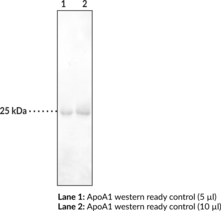
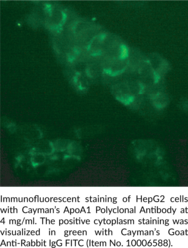
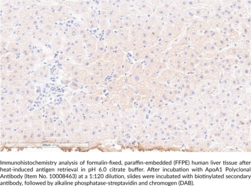
    ApoA1 is a major protein component in high-density lipoproteins (HDLs). It acts as an acceptor for sequential transfers of phospholipids and free cholesterol from peripheral tissues as well as transporting cholesterol to the liver and other tissues for excretion and steroidogenesis.1 Serum ApoA1 levels are inversely related to the risk of developing atherosclerosis.2 Loss-of-function mutations in ApoA1 are causes of diseases such as HDL deficiency type 1 (or Tangier disease) and type 2 (familial hypoalphalipoproteinemia), and systemic non-neuropathic amyloidosis.3,4 Liver and small intestine are two main sources of the protein. Cayman’s ApoA1 Polyclonal Antibody detects the protein by WB analysis at 25 kDa in tissue/cell samples such as liver, intestine, and HepG2 cells.

    WARNING This product is not for human or veterinary use.

    References & Product Citations
    Product Description References

    1. Ajees, A.A., Anantharamaiah, G.M., Mishra, V.K., et alCrystal structure of human apolipoprotein A-I: Insights into its protective effect against cardiovascular diseases. Proc. Natl. Acad. Sci. USA 103(7), 2126-2131 (2006).

    2. Haas, M.J., Reinacher, D., Li, J.P., et alRegulation of apoA1 gene expression with acidosis: Requirement for a transcriptional repressor. J. Mol. Endocrinol. 27(1), 43-57 (2001).

    3. Tall, A.R., and Wang, N. Tangier disease as a test of the reverse cholesterol transport hypothesis. J. Clin. Invest. 106(10), 1205-1207 (2000).

    4. Cheung, M.C., Mendez, A.J., Wolf, A.C., et alCharacterization of apolipoprotein A-I- and A-II-containing lipoproteins in a new case of high density lipoprotein deficiency resembling tangier disease and their effects on intracellular cholesterol efflux. J. Clin. Invest. 91(2), 522-529 (1993).