
An S1P2 and S1P4 receptor antagonist
Technical Support & Resources

Visit our FAQ

Contact Us

Toll Free Phone (USA and Canada Only): (888) 526-5351
Direct Phone: (734) 975-3888
Request Technical Support

Technical Support Request

To streamline the process attach the appropriate questionnaire to your inquiry.

Download IHC QuestionnaireDownload WB Questionnaire

View Our Privacy Statement for details on how we use and protect your data. In addition, this site is protected by hCaptcha and its Privacy Policy and Terms of Service apply.

JTE-013

Item No. 10009458

Technical Information
Formal Name
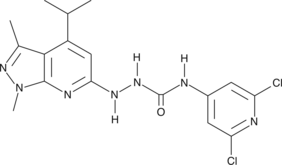
N-(2,6-dichloro-4-pyridinyl)-2-[1,3-dimethyl-4-(1-methylethyl)-1H-pyrazolo[3,4-b]pyridin-6-yl]-hydrazinecarboxamide
CAS Number
383150-41-2
Molecular Formula
C17H19Cl2N7O
Formula Weight
Purity
≥98%
Formulation
A crystalline solid
DMF: 20 mg/mlDMSO: 20 mg/mlEthanol: 30 mg/mlEthanol:PBS (pH 7.2) (1:3): 0.25 mg/ml
λmax
216, 248, 304 nm
SMILES
O=C(NNc1cc(C(C)C)c2c(C)nn(C)c2n1)Nc1cc(Cl)nc(Cl)c1
InChi Code
InChI=1S/C17H19Cl2N7O/c1-8(2)11-7-14(22-16-15(11)9(3)25-26(16)4)23-24-17(27)20-10-5-12(18)21-13(19)6-10/h5-8H,1-4H3,(H,22,23)(H2,20,21,24,27)
InChi Key
RNSLRQNDXRSASX-UHFFFAOYSA-N
License
Cayman and its customers are licensed to make, have made, sell and use the polynucleotides encoding the S1P2 (Sphingosine 1-Phosphate Receptor 2/ aka Edg 5/ aka PH218) receptor, complementary polynucleotides, and polypeptides and all matter claimed in U.S. Patent No. 5,585,476, U.S. Patent No. 5,856,443, and U.S. Patent No. 6,518,414B1. THIS LICENSE DOES NOT EXTEND TO THE MANUFACTURE AND SALE OF ANY DRUG PRODUCT. Notwithstanding any express or implied warranties to the contrary, including but not limited to Uniform Commercial Code § 2-312(3), Cayman expressly disclaims any and all liability for any claims arising out of or relating to the manufacture and sale of drug products using polynucleotides encoding the S1P2 (Sphingosine 1-Phosphate Receptor 2/ aka Edg 5/ aka PH218) receptor, complementary polynucleotides, and polypeptides or any matter claimed in U.S. Patent No. 5,585,476, U.S. Patent No. 5,856,443, and U.S. Patent No. 6,518,414B1.
Shipping & Storage Information
Storage
-20°C
Shipping
Room temperature in continental US; may vary elsewhere
Recommended Products

Certificates of Analysis & Batch Specific Data

Provide batch numbers separated by commas to download or request available product inserts, QC sheets, certificates of analysis, data packs, and GC-MS data.

    Add

    Add

    Add

    Add

    Lipid Resource Center
    Discover Products & Resources for Lipid Research
    • High-purity lipid standards
    • Lipid roles in biology
    • Lipids in health & disease
    • Lipids for pharmaceutical development
    • Protocols, advice, & resources
    EXPLORE NOW
    Product Description

    JTE-013 is a sphingosine-1-phosphate receptor 2 (S1P2) and S1P4 antagonist (IC50s = 17 and 237 nM, respectively).1 It is selective for S1P2 over S1P1 and S1P3 (IC50s = >10 µM for both).1,2 JTE-013 (1 and 10 µM) reverses S1P-induced inhibition of human umbilical vein endothelial cell (HUVEC) and smooth muscle cell (SMC) migration.2 It also reverses S1P-induced inhibition of B16 murine melanoma cell migration.3 In vivo, JTE-013 (30 mg/kg) reduces lung injury, endothelial dysfunction, and pulmonary edema in a rat model of cecal ligation and puncture-induced sepsis.4 JTE-013 also inhibits sphingolipid delta(4)-desaturase (DES1; IC50 = 16.8 µM), an effect that is not rescued by the S1P2 agonist CYM5520, as well as sphingosine kinase 1 (SK1) and SK2 (IC50s = 25.1 and 4.3 µM, respectively).1

    WARNING This product is not for human or veterinary use.

    References & Product Citations
    Product Description References

    1. Pitman, M., Lewis, A.C., Davies, L.T., et alThe sphingosine 1-phosphate receptor 2/4 antagonist JTE-013 elicits off-target effects on sphingolipid metabolism. Sci. Rep. 12(1), 454 (2022).

    2. Osada, M., Yatomi, Y., Ohmori, T., et alEnhancement of sphingosine 1-phosphate-induced migration of vascular endothelial cells and smooth muscle cells by an EDG-5 antagonist. Biochem. Biophys. Res. Commun. 299(3), 483-487 (2002).

    3. Arikawa, K., Takuwa, N., Yamaguchi, H., et alLigand-dependent inhibition of B16 melanoma cell migration and invasion via endogenous S1P2 G protein-coupled receptor. Requirement of inhibition of cellular rac activity. The Journal of Biological Chemisty 278(35), 32841-32851 (2003).

    4. Xu, Q., Chen, J., Zhu, Y., et alJTE-013 alleviates inflammatory injury and endothelial dysfunction induced by sepsis in vivo and in vitro. J. Surg. Res. 265, 323-332 (2021).

    Product Citations

    Pitman, M., Lewis, A.C., Davies, L.T., et alThe sphingosine 1-phosphate receptor 2/4 antagonist JTE-013 elicits off-target effects on sphingolipid metabolism. Sci. Rep. 12(1), 454 (2022).

    Wang, M., Wu, H., Wang, R., et alInhibition of sphingosine 1-phosphate (S1P) receptor ½/3 ameliorates biological dysfunction in rheumatoid arthritis fibroblast-like synoviocyte MH7A cells through Gαi/Gαs rebalancing. Clin. Exp. Pharmacol. Physiol. 48(8), 1080-1089 (2021).

    Dusaban, S.S., Chun, J., Rosen, H., et alSphingosine 1-phosphate receptor 3 and RhoA signaling mediate inflammatory gene expression in astrocytes. J. Neuroinflammation 14(1), 111 (2017).

    Al Alam, N., and Kreydiyyeh, S.I. FTY720P inhibits hepatic Na+-K+ ATPase via S1PR2 and PGE2. Biochem. Cell Biol. 94(4), 371-377 (2016).

    Beach, J.A., Aspuria, P.J., Cheon, D.J., et alSphingosine kinase 1 is required for TGF-β mediated fibroblast-to-myofibroblast differentiation in ovarian cancer. Oncotarget 7(4), 4167-4182 (2016).

