I-FABP; Fatty Acid Binding Protein 2; Intestinal-FABP
Technical Support & Resources

Visit our FAQ

Contact Us

Toll Free Phone (USA and Canada Only): (888) 526-5351
Direct Phone: (734) 975-3888

Request Technical Support

Technical Support Request

To streamline the process attach the appropriate questionnaire to your inquiry.

Download IHC QuestionnaireDownload WB Questionnaire

View Our Privacy Statement for details on how we use and protect your data. In addition, this site is protected by hCaptcha and its Privacy Policy and Terms of Service apply.

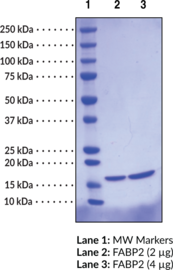
FABP2 (human recombinant)

Item No. 10009548

Technical Information
Synonyms
  • Fatty Acid Binding Protein 2
  • I-FABP
  • Intestinal-FABP
Purity
≥95%
Source
Recombinant N-terminal His-tagged protein expressed in E. coli
MW
19.3 kDa
50 mM sodium phosphate, pH 7.2, containing 20% glycerol, 100 mM sodium chloride, and 1 mM DTT
Shipping & Storage Information
Storage
-80°C
Shipping
Dry ice in continental US; may vary elsewhere
Recommended Products

Certificates of Analysis & Batch Specific Data

Provide batch numbers separated by commas to download or request available product inserts, QC sheets, certificates of analysis, data packs, and GC-MS data.

    Add

    Cayman Chemical
    Explore Obesity & Metabolic Disease Resources

    Discover high-quality research tools to investigate GLP-1 mechanisms and next-generation metabolic targets.

    OBESITY RESEARCH SOLUTIONS
    Product Description

    Fatty acid binding protein 2 (FABP2) is one of nine known cytosolic FABPs ranging in size from 14-15 kDa containing 127-132 amino acids.1 Members of this protein family exhibit high-affinity for small lipophilic ligands and were named according to the tissue from which they were initially isolated.1 Studies suggest that FABPs are involved in the uptake and metabolism of fatty acids, in the maintenance of cellular membrane fatty acid levels, in intracellular trafficking of these substrates, in the modulation of specific enzymes of lipid metabolic pathways, and in the modulation of cell growth and differentiation.2 FABP family members have highly conserved three dimensional structures and 22-73% amino acid sequence similarity. FABP2 is composed of ten antiparallel b strands that form a barrel and binds the ligand in a bent confirmation. It is exclusively expressed in the intestinal enterocytes and is potentially a plasma marker for intestinal injury. FABP2 polymorphism has been suggested to be associated with gender specific obesity and increased risk of diabetes.1

    WARNING This product is not for human or veterinary use.

    References & Product Citations
    Product Description References

    1. Zimmerman, A.W., and Veerkamp, J.H. New insights into the structure and function of fatty acid-binding proteins. Cell. Mol. Life Sci. 59(7), 1096-1116 (2002).

    2. Massolini, G., and Calleri, E. Survey of binding properties of fatty acid-binding proteins chromatographic methods. J. Chromatogr. B Analyt. Technol. Biomed. Life Sci. 797(1-2), 255-268 (2003).