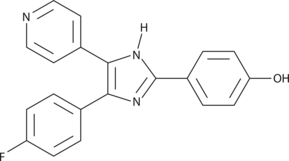
A specific and potent p38 MAP kinase inhibitor
Related Products
Technical Support & Resources

Information provided in the product description is from published literature. Due to the nature of scientific experimentation, your results (e.g., selectivity and effective concentrations) or specific application for this product may differ. If you have questions about how this product fits your application, please contact our technical support staff.

Visit our FAQ

Contact Us

Toll Free Phone (USA and Canada Only): (888) 526-5351
Direct Phone: (734) 975-3888

Request Technical Support

Technical Support Request

To streamline the process attach the appropriate questionnaire to your inquiry.

Download IHC QuestionnaireDownload WB Questionnaire

View Our Privacy Statement for details on how we use and protect your data. In addition, this site is protected by hCaptcha and its Privacy Policy and Terms of Service apply.

SB 202190

Item No. 10010399

Technical Information
Formal Name
4-[4-(4-fluorophenyl)-5-(4-pyridinyl)-1H-imidazol-2-yl]-phenol
CAS Number
152121-30-7
Molecular Formula
C20H14FN3O
Formula Weight
Purity
≥98%
A crystalline solid
DMF: 10 mg/mlDMSO: 16 mg/mlDMSO:PBS (pH 7.2) (1:6): 0.14 mg/mlEthanol: 0.25 mg/ml
λmax
202, 295 nm
SMILES
FC(C=C1)=CC=C1C(N=C(C2=CC=C(O)C=C2)N3)=C3C4=CC=NC=C4
InChi Code
InChI=1S/C20H14FN3O/c21-16-5-1-13(2-6-16)18-19(14-9-11-22-12-10-14)24-20(23-18)15-3-7-17(25)8-4-15/h1-12,25H,(H,23,24)
InChi Key
QHKYPYXTTXKZST-UHFFFAOYSA-N
Shipping & Storage Information
Storage
-20°C
Shipping
Room temperature in continental US; may vary elsewhere
Recommended Products

Certificates of Analysis & Batch Specific Data

Provide batch numbers separated by commas to download or request available product inserts, QC sheets, certificates of analysis, data packs, and GC-MS data.

    Add

    Add

    Add

    Add

    Kinase Resource Center
    Discover Products & Resources for Kinase Research
    • Kinase inhibitors, screening libraries, assay kits, & more
    • Tools to study kinase signaling pathways:
      • Growth factor signaling
      • PI3K/Akt/mTOR
      • MAPKs (ERK, p38, & JNK)
      • JAK/STAT signaling
    • Articles, resources, & advice
    EXPLORE NOW
    Product Description

    SB 202190 is a selective, potent, cell-permeable inhibitor of p38 MAP kinases, inhibiting p38α (SAPK2A, MAPK14) and p38β (SAPK2B, MAPK11) with IC50 values of 50 and 100 nM, respectively.1,2 When tested at 10 μM, SB 202190 has negligible effects on a range of other kinases, including other MAP kinases (ERKs, JNKs).2 Pyridinyl imidazole inhibitors, including this compound, directly bind p38 MAP kinases in the ATP binding pocket.3 Recently, SB 202190 has been used to elucidate the roles of p38 MAP kinases in inflammatory cytokine expression, nicotine-induced receptor expression, and HIV-mediated depressive disorder.4,5,6 SB 202474 (Item No. 18749), a negative control for SB 202190, is also available from Cayman.

    WARNING This product is not for human or veterinary use.

    References & Product Citations
    Product Description References

    1. Jiang, Y., Chen, C., Li, Z., et alCharacterization of the structure and function of a new mitogen-activated protein kinase (p38β). The Journal of Biological Chemisty 271(30), 17920-17926 (1996).

    2. Davies, S.P., Reddy, H., Caivano, M., et alSpecificity and mechanism of action of some commonly used protein kinase inhibitors. Biochem. J. 351(1), 95-105 (2000).

    3. Fox, T., Coll, J.T., Xie, X., et alA single amino acid substitution makes ERK2 susceptible to pyridinyl imidazole inhibitors of p38 MAP kinase. Protein Sci. 7(11), 2249-2255 (1998).

    4. Fu, X., Lawson, M.A., Kelley, K.W., et alHIV-1 Tat activates indoleamine 2,3 dioxygenase in murine organotypic hippocampal slice cultures in a p38 mitogen-activated protein kinase-dependent manner. J. Neuroinflammation 8(88), 1-12 (2011).

    5. Riis, J.L., Johansen, C., Vestergaard, C., et alCCL27 expression is regulated by both p38 MAPK and IKKβ signalling pathways. Cytokine 56(3), 699-707 (2011).

    6. Röthig, A., Schreckenberg, R., Weber, K., et alEffects of nicotine on PTHrP and PTHrP receptor expression in rat coronary endothelial cells. Cell Physiol. Biochem. 29(3-4), 485-492 (2012).