
Technical Support & Resources
Visit our FAQ
Contact Us
Toll Free Phone (USA and Canada Only): (888) 526-5351
Direct Phone: (734) 975-3888
Product Categories
Research Area
Acetyl Lysine Monoclonal Antibody (Clone 7F8)
Item No. 10010567
Technical Information
- ACE
Shipping & Storage Information
Recommended Products
Certificates of Analysis & Batch Specific Data
Provide batch numbers separated by commas to download or request available product inserts, QC sheets, certificates of analysis, data packs, and GC-MS data.
Lipid Resource Center
Discover Products & Resources for Lipid Research
- High-purity lipid standards
- Lipid roles in biology
- Lipids in health & disease
- Lipids for pharmaceutical development
- Protocols, advice, & resources
Product Description
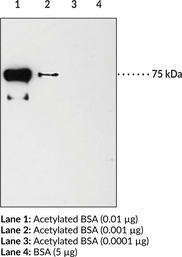
Lysine acetylation is an evolutionarily conserved posttranslational modification that is found in prokaryotes and eukaryotes at histone and non-histone protein sites.1 Transfer of an acetyl group from acetyl-coenzyme A (acetyl-CoA) to the amino side chain of lysine is catalyzed by lysine acetyltransferases (KATs), including 13 canonical KATs from the GCN5, p300, and MYST families. Acetyl lysine removal is catalyzed by two major groups of lysine deacetylases (KDACs), the zinc-dependent histone deacetylases (HDACs) and the NAD+-dependent sirtuin deacetylases. Histone acetylation is associated with active gene transcription, and dysregulation of histone acetylation is associated with various diseases including cancer, Huntington's and Alzheimer's diseases, and amyotrophic lateral sclerosis (ALS).2,3,4 Non-histone protein acetylation is linked to various cellular processes including autophagy, DNA replication, lipid storage, mitochondrial fission and fusion, and protein synthesis, among others.1 Cayman's Acetyl Lysine Monoclonal Antibody (Clone 7F8) can be used for ELISA, immunocytochemistry (ICC), and Western blot applications.
WARNING This product is not for human or veterinary use.
References & Product Citations
1. Functions and mechanisms of non-
2. Histone modifications and cancer. Cold Spring Harb. Perspect. 8(4), a019521 (2016).
3. Histone acetylation in neuronal (dys)function. Biomol. Concepts 7(2), 103-116 (2016).
4. Epigenetics in amyotrophic lateral sclerosis: A role for histone post-
Contact Info
Cayman Chemical1180 East Ellsworth RoadAnn Arbor, Michigan 48108 USAToll Free: (800) 364-9897(USA and Canada only)Fax: (734) 971-3640


