
Technical Support & Resources
Information provided in the product description is from published literature. Due to the nature of scientific experimentation, your results (e.g., selectivity and effective concentrations) or specific application for this product may differ. If you have questions about how this product fits your application, please contact our technical support staff.
Visit our FAQ
Contact Us
Toll Free Phone (USA and Canada Only): (888) 526-5351
Direct Phone: (734) 975-3888
Product Categories
Technical Information
Shipping & Storage Information
Recommended Products
Certificates of Analysis & Batch Specific Data
Provide batch numbers separated by commas to download or request available product inserts, QC sheets, certificates of analysis, data packs, and GC-MS data.
Lipid Resource Center
Discover Products & Resources for Lipid Research
- High-purity lipid standards
- Lipid roles in biology
- Lipids in health & disease
- Lipids for pharmaceutical development
- Protocols, advice, & resources
Product Description
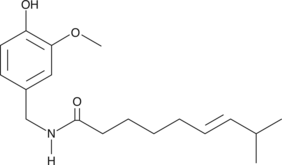
Capsaicin is a terpene alkaloid that has been found in Capsicum and has diverse biological activities.1,2,3,4 It induces inward currents in HEK293 cells expressing rat transient receptor potential vanilloid 1 (TRPV1; EC50 = 0.64 µM at neutral pH), an effect that can be blocked by the TRPV1 inhibitor A-425619.1 Capsaicin (10 and 50 µM) decreases LPS-induced prostaglandin E2 (PGE2; Item No. 14010) production, as well as reduces LPS- and IFN-induced nitric oxide (NO) release in isolated mouse peritoneal macrophages.2 Capsaicin induces substance P (Item No. 24035) release in rat spinal cord slices with an EC50 value of 2.3 µM.3 It reduces acetylcholine- or phenylquinone-induced writhing (ED50s = 1.33 and 1.38 mg/kg, respectively, s.c.) but has no effect on the latency to paw withdrawal in the hot plate test in mice (ED50 = >20 mg/kg, s.c.).4 Formulations containing capsaicin have been used in the treatment of nerve pain associated with shingles.
WARNING This product is not for human or veterinary use.
References & Product Citations
1. Acidification of rat TRPVI alters the kinetics of capsaicin responses. Mol. Pain 1, 28 (2005).
2. Capsaicin exhibits anti-
3. Relationship between capsaicin-
4. Effects of single doses of capsaicin on nociceptive thresholds in the rodent. Neuropharmacology 20(5), 505-511 (1981).
Contact Info
Cayman Chemical1180 East Ellsworth RoadAnn Arbor, Michigan 48108 USAToll Free: (800) 364-9897(USA and Canada only)Fax: (734) 971-3640


