
Technical Support & Resources
Information provided in the product description is from published literature. Due to the nature of scientific experimentation, your results (e.g., selectivity and effective concentrations) or specific application for this product may differ. If you have questions about how this product fits your application, please contact our technical support staff.
Visit our FAQ
Contact Us
Toll Free Phone (USA and Canada Only): (888) 526-5351
Direct Phone: (734) 975-3888
Technical Information
- SP
Shipping & Storage Information
Recommended Products
Certificates of Analysis & Batch Specific Data
Provide batch numbers separated by commas to download or request available product inserts, QC sheets, certificates of analysis, data packs, and GC-MS data.
Product Description
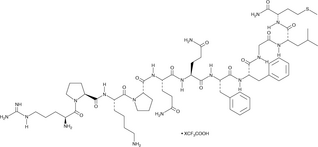
Substance P is tachykinin neuropeptide that selectively binds to neurokinin 1 (NK1) receptors (Kis = 0.14 and 300 nM for NK1 and NK3, respectively) and has diverse biological activities.1,2 It is an endogenous peptide expressed in the central and peripheral nervous systems, including the enteric nervous system and in immune cells.2 Substance P is released with other neurotransmitters in the dorsal horn of the spinal cord following noxious peripheral stimulation and induces pain through NK1 receptors.3 The NK1 receptor is internalized following substance P binding, and in a rat hindpaw model of inflammation it is internalized in a greater number of spinal cord neurons following a mechanical or non-noxious stimuli, indicating a role for substance P in inflammation and hyperalgesia.4 Substance P is also involved in depression, anxiety, seizures, and emesis among other functions.2
WARNING This product is not for human or veterinary use.
References & Product Citations
1. Different binding epitopes on the NK1 receptor for substance P and non-
2. Involvement of substance P and the NK-
3. Neurobiology of substance P and the NK1 receptor. J. Clin. Psychiatry 63(Suppl 11), 6-10 (2002).
4. Inflammation increases the distribution of dorsal horn neurons that internalize the neurokinin-
Contact Info
Cayman Chemical1180 East Ellsworth RoadAnn Arbor, Michigan 48108 USAToll Free: (800) 364-9897(USA and Canada only)Fax: (734) 971-3640


