
An iminosugar with diverse biological activities
Related Products
Technical Support & Resources

Information provided in the product description is from published literature. Due to the nature of scientific experimentation, your results (e.g., selectivity and effective concentrations) or specific application for this product may differ. If you have questions about how this product fits your application, please contact our technical support staff.

Visit our FAQ

Contact Us

Toll Free Phone (USA and Canada Only): (888) 526-5351
Direct Phone: (734) 975-3888

Request Technical Support

Technical Support Request

To streamline the process attach the appropriate questionnaire to your inquiry.

Download IHC QuestionnaireDownload WB Questionnaire

View Our Privacy Statement for details on how we use and protect your data. In addition, this site is protected by hCaptcha and its Privacy Policy and Terms of Service apply.

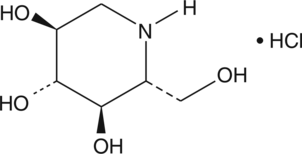
1-Deoxynojirimycin (hydrochloride)

Item No. 10011718
Technical Information
Formal Name
2R-(hydroxymethyl)-3R,4R,5S-piperidinetriol, monohydrochloride
CAS Number
73285-50-4
Synonyms
  • 1-DNJ
  • 1-dNM
  • Moranoline
Molecular Formula
C6H13NO4 • HCl
Formula Weight
Purity
≥95%
A crystalline solid
DMSO: 10 mg/mlPBS (pH 7.2): 1 mg/ml
SMILES
O[C@H]1[C@H](O)[C@@H](O)CN[C@@H]1CO.Cl
InChi Code
InChI=1S/C6H13NO4.ClH/c8-2-3-5(10)6(11)4(9)1-7-3;/h3-11H,1-2H2;1H/t3-,4+,5-,6-;/m1./s1
InChi Key
ZJIHMALTJRDNQI-VFQQELCFSA-N
Origin
Synthetic
Shipping & Storage Information
Storage
-20°C
Shipping
Room temperature in continental US; may vary elsewhere
Recommended Products

Certificates of Analysis & Batch Specific Data

Provide batch numbers separated by commas to download or request available product inserts, QC sheets, certificates of analysis, data packs, and GC-MS data.

    Add

    Add

    Add

    Add

    Cayman Chemical
    Explore Obesity & Metabolic Disease Resources

    Discover high-quality research tools to investigate GLP-1 mechanisms and next-generation metabolic targets.

    OBESITY RESEARCH SOLUTIONS
    Product Description

    1-Deoxynojirimycin (1-DNJ) is an iminosugar that has been found in M. alba (mulberry) leaves and has diverse biological activities.1,2,3,4,5,6 It inhibits the activities of α- and β-glucosidase (IC50s = 35 and 71 µM, respectively).2 1-DNJ (5 mM) reduces the formation of N-linked complex oligosaccharides in IEC-6 cells.3 It inhibits HIV-1 envelope-mediated membrane fusion in CEM cells when used at a concentration of 2 mM.4 1-DNJ (1-100 µg/ml) reduces the invasion and migration of B16/F10 mouse melanoma cells.5 It improves glucose and insulin tolerance in db/db mice when administered intravenously at doses ranging from 20 to 80 mg/kg per day for four weeks.6

    WARNING This product is not for human or veterinary use.

    References & Product Citations
    Product Description References

    1. Gao, K., Zheng, C., Wang, T., et al1-Deoxynojirimycin: Occurrence, extraction, chemistry, oral pharmacokinetics, biological activities and in silico target fishing. Molecules 21(11), 1600 (2016).

    2. Ahuja-Casarín, A.I., Merino-Montiel, P., Vega-Baez, J.L., et alTuning the activity of iminosugars: Novel N-alkylated deoxynojirimycin derivatives as strong BuChE inhibitors. J. Enzyme Inhib. Med. Chem. 36(1), 138-146 (2021).

    3. Codelli, J.A., Baskin, J.M., Agard, N.J., et alSecond-generation difluorinated cyclooctynes for copper-free click chemistry. J. Am. Chem. Soc. 130(34), 11486-11493 (2008).

    4. Papandréou, M.-J., Barbouche, R., Guieu, R., et alThe α-glucosidase inhibitor 1-deoxynojirimycin blocks human immunodeficiency virus envelope glycoprotein-mediated membrane fusion at the CXCR4 binding step. Mol. Pharmacol. 61(1), 186-193 (2002).

    5. Wang, R.-J., Yang, C.-H., and Hu, M.-L. 1-Deoxynojirimycin inhibits metastasis of B16F10 melanoma cells by attenuating the activity and expression of matrix metalloproteinases-2 and -9 and altering cell surface glycosylation. J. Agric. Food Chem. 58(16), 8988-8993 (2010).

    6. Liu, Q., Li, X., Li, C., et al1-Deoxynojirimycin alleviates insulin resistance via activation of insulin signaling PI3K/AKT pathway in skeletal muscle of db/db mice. Molecules 20(12), 21700-21714 (2015).

