
Log InRegister
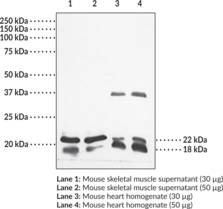
For immunochemical detection of caveolin-1/3
Technical Support & Resources
Visit our FAQ
Contact Us
Toll Free Phone (USA and Canada Only): (888) 526-5351
Direct Phone: (734) 975-3888
Request Technical Support
Product Categories
Research Area
Application
Technical Information
Synonyms
- Cav-1/3
Immunogen
Synthetic peptide from the N-terminal region of rat caveolin-3
Formulation (Request formulation change)
Polyclonal antiserum
Storage Buffer
Polyclonal antiserum when reconstituted in 100 μl of double distilled water
Host
Rabbit
Applications
WB; other applications not tested
Cross Reactivity
(+) Caveolin-1(+) Caveolin-3
Species Reactivity
(+) Human(+) Murine(+) Rat
UniProt Accession №
P51638
Origin
Animal/Rabbit
Shipping & Storage Information
Storage
-20°C
Shipping
Wet ice in continental US; may vary elsewhere
Recommended Products
Certificates of Analysis & Batch Specific Data
Provide batch numbers separated by commas to download or request available product inserts, QC sheets, certificates of analysis, data packs, and GC-MS data.
References & Product Citations
Product Description References
1. Endothelial nitric oxide synthase targeting to caveolae. Specific interactions with caveolin isoforms in cardiac myocytes and endothelial cells. The Journal of Biological Chemisty 271(37), 22810-22814 (1996).
2. Molecular cloning of caveolin-
Contact Info
Cayman Chemical1180 East Ellsworth RoadAnn Arbor, Michigan 48108 USAToll Free: (800) 364-9897(USA and Canada only)Fax: (734) 971-3640


