
Technical Support & Resources
Visit our FAQ
Contact Us
Toll Free Phone (USA and Canada Only): (888) 526-5351
Direct Phone: (734) 975-3888
Technical Information
- Anandamide Amidohydrolase 1
- FAAH
- Oleamide Hydrolase 1
- PSAB
Shipping & Storage Information
Recommended Products
Certificates of Analysis & Batch Specific Data
Provide batch numbers separated by commas to download or request available product inserts, QC sheets, certificates of analysis, data packs, and GC-MS data.
Lipid Resource Center
Discover Products & Resources for Lipid Research
- High-purity lipid standards
- Lipid roles in biology
- Lipids in health & disease
- Lipids for pharmaceutical development
- Protocols, advice, & resources
Product Description
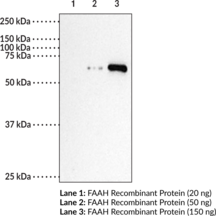
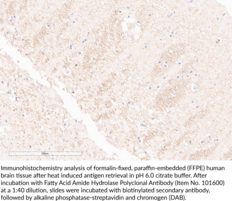
Fatty acid amide hydrolase (FAAH) is a serine hydrolase with a major role in the hydrolysis of endocannabinoids.1,2,3 It is composed of an N-terminal transmembrane domain, a catalytic domain containing an amidase signature sequence, a polyproline sequence, and a monotopic membrane binding domain.3 FAAH is localized to microsomal and mitochondrial membranes and is highly expressed in the CNS but can also be found in peripheral tissues such as lung, gastrointestinal tract, kidney, liver, bladder, prostate, and testis.4,2 It primarily catalyzes the inactivation of the endogenous endocannabinoid arachidonoyl ethanolamide (AEA; Item No. 90050) via hydrolysis to arachidonic acid and ethanolamine but has broad substrate selectivity towards fatty acid amides, including oleamide, N-acyltaurines, and other N-acylethanolamines.2 Genetic or pharmacologic knockdown of FAAH increases levels of AEA and dampens pain sensitivities and inflammatory endpoints in rodent models of inflammatory pain, allergic contact dermatitis, inflammatory bowel disease, and neuropathic pain.5 Cayman's Fatty Acid Amide Hydrolase Polyclonal Antibody can be used for immunohistochemistry (IHC) and Western blot (WB) applications.
WARNING This product is not for human or veterinary use.
References & Product Citations
1. Molecular characterization of an enzyme that degrades neuromodulatory fatty-
2. Targeting endocannabinoid signaling: FAAH and MAG lipase inhibitors. Annu. Rev. Pharmacol. Toxicol. 61, 441-463 (2021).
3. Fatty acid amide hydrolase as a potential therapeutic target for the treatment of pain and CNS disorders. Expert Opin. Drug Discov. 4(7), 763-784 (2009).
4. The fatty acid amide hydrolase (FAAH). Prostaglandins Leukot. Essent. Fatty Acids 66(2-3), 201-210 (2002).
5. Targeting fatty acid amide hydrolase (FAAH) to treat pain and inflammation. AAPS J. 11(1), 39-44 (2009).
Expression and localization of CB1R, NAPE-
Adverse social experiences in adolescent rats result in enduring effects on social competence, pain sensitivity and endocannabinoid signaling. Front. Behav. Neurosci. 10, (2016).
Ulcerative colitis induces changes on the expression of the endocannabinoid system in the human colonic tissue. PLoS One 4(9), e6893 (2009).
Expression and function of fatty acid amide hydrolase in protstate cancer. Int. J. Cancer 123(6), 1318-1326 (2008).
Contact Info
Cayman Chemical1180 East Ellsworth RoadAnn Arbor, Michigan 48108 USAToll Free: (800) 364-9897(USA and Canada only)Fax: (734) 971-3640


