For immunochemical detection of PPARδ
Technical Support & Resources

Visit our FAQ

Contact Us

Toll Free Phone (USA and Canada Only): (888) 526-5351
Direct Phone: (734) 975-3888

Request Technical Support

Technical Support Request

To streamline the process attach the appropriate questionnaire to your inquiry.

Download IHC QuestionnaireDownload WB Questionnaire

View Our Privacy Statement for details on how we use and protect your data. In addition, this site is protected by hCaptcha and its Privacy Policy and Terms of Service apply.

PPARδ Polyclonal Antibody

Item No. 101720

Technical Information
Synonyms
  • FAAR
  • NUC1
  • Nuclear Hormone Receptor 1
  • PPARβ
Immunogen
Synthetic peptide from the N-terminal region of human PPARδ
500 µl Peptide affinity-purified polyclonal antibody
Storage Buffer
PBS, pH 7.2, with 50% glycerol and 0.02% sodium azide
Host
Rabbit
Applications
IHC and WB
Species Reactivity
(+) Human(+) Mouse
UniProt Accession №
Q03181
Origin
Animal/Rabbit
Shipping & Storage Information
Storage
-20°C
Shipping
Wet ice in continental US; may vary elsewhere
Recommended Products

Certificates of Analysis & Batch Specific Data

Provide batch numbers separated by commas to download or request available product inserts, QC sheets, certificates of analysis, data packs, and GC-MS data.

    Add

    Cayman Chemical
    Explore Obesity & Metabolic Disease Resources

    Discover high-quality research tools to investigate GLP-1 mechanisms and next-generation metabolic targets.

    OBESITY RESEARCH SOLUTIONS
    Product Description

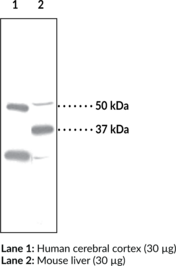
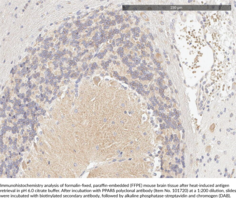
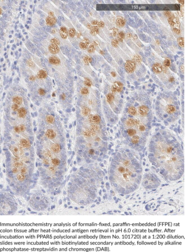
    PPARδ is one of three peroxisome proliferator-activated receptor (PPAR) subtypes that possess a domain structure common to other members of the nuclear receptor gene family. It was first cloned from Xenopus laevis and named PPARβ.1 PPARδ is ubiquitously expressed but is particularly abundant in tissues such as liver, intestine, kidney, abdominal adipose, and skeletal muscle, all of which are involved in lipid metabolism.2 PPARδ is a mediator of diverse physiological functions including lipid and cholesterol homeostasis, embryo implantation, and cancer development.3,4,5,6 Most recently, attention has been focused on the role of PPARδ in obesity.7 Cayman’s PPARδ polyclonal antibody can be used for Western blot and immunohistochemistry to study the expression and functions of this protein. The antibody recognizes PPARδ at 50 kDa from human samples. An additional smaller size of PPARδ (~ 40 kDa)8 is also detected in certain mouse tissues.

    WARNING This product is not for human or veterinary use.

    References & Product Citations
    Product Description References

    1. Dreyer, C., Krey, G., Keller, H., et alControl of the peroxisomal β-oxidation pathway by a novel family of nuclear hormone receptors. Cell 68, 879-887 (1992).

    2. Willson, T.M., Brown, P.J., Sternbach, D.D., et alThe PPARs: From orphan receptors to drug discovery. J. Med. Chem. 43(4), 527-550 (2000).

    3. Amri, E.Z., Bonino, F., Ailhaud, G., et alCloning of a protein that mediates transcriptional effects of fatty acids in preadipocytes. Homology to peroxisome proliferator-activated receptors. The Journal of Biological Chemisty 270, 2367-2371 (1995).

    4. Berger, J., Leibowitz, M.D., Doebber, T.W., et alNovel peroxisome proliferator-activated receptor (PPAR) γ and PPARδ ligands produce distinct biological effects. The Journal of Biological Chemisty 574(10), 6718-6725 (1999).

    5. Lim, H., and Dey, S.K. PPARδ functions as a prostacyclin receptor in blastocyst implantation. Trends Endocrinol. Metab. 11(4), 137-142 (2000).

    6. He, T.-C., Chan, T.A., Vogelstein, B., et alPPARδ is an APC-regulated target of nonsteroidal anti-inflammatory drugs. Cell 99(3), 335-345 (1999).

    7. Wang, Y.-X., Lee, C.-H., Tiep, S., et alPeroxisome-proliferator-activated receptor δ activates fat metabolism to prevent obesity. Cell 113(2), 159-170 (2003).

    8. Mammalian Gene Collection Program, T. Generation and initial analysis of more than 15,000 full-length human and mouse cDNA sequences. Proc. Natl. Acad. Sci. USA 99(26), 16899-16903 (2002).

    Product Citations

    Reddy, A.T., Lakshmi, S.P., Banno, A., et alIdentification and Molecular Characterization of PPARδ as a Novel Target for Covalent Modification by 15-deoxy-Δ12, 14-prostaglandin J2. ACS Chem. Biol. (2018).

    Change, Y.-C., Chen, Y.-J., Huang, C.-W., et alCyclic stretch facilitates myogenesis in C2C12 myoblasts and rescues thiazolidinedione-inhibited myotube formation. Front. Bioeng. Biotechnol. 4(27), (2016).

    Wang, X., Wang, G., Shi, Y., et alPPAR-delta promotes survival of breast cancer cells in harsh metabolic conditions. Oncogenesis 5, e232 (2016).