
Technical Support & Resources
Information provided in the product description is from published literature. Due to the nature of scientific experimentation, your results (e.g., selectivity and effective concentrations) or specific application for this product may differ. If you have questions about how this product fits your application, please contact our technical support staff.
Visit our FAQ
Contact Us
Toll Free Phone (USA and Canada Only): (888) 526-5351
Direct Phone: (734) 975-3888
Product Categories
Technical Information
- AEA-
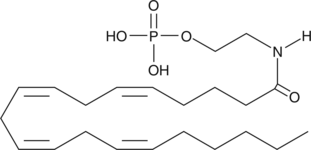
P - Anandamide Phosphate
Shipping & Storage Information
Recommended Products
Certificates of Analysis & Batch Specific Data
Provide batch numbers separated by commas to download or request available product inserts, QC sheets, certificates of analysis, data packs, and GC-MS data.
Lipid Resource Center
Discover Products & Resources for Lipid Research
- High-purity lipid standards
- Lipid roles in biology
- Lipids in health & disease
- Lipids for pharmaceutical development
- Protocols, advice, & resources
Product Description
Arachidonoyl ethanolamide (AEA; Item No. 90050) was the first endogenous cannabinoid (CB) to be isolated and characterized as an agonist acting on the same receptors (CB1 and CB2) as Δ9-THC (Item No. 12068).1,2 Since that time, a number of related endocannabinoids have been isolated, most notably 2-arachidonoyl glycerol (2-AG; Item No. 62160).2 The phosphate ester of AEA, AEA-P, has been tested as a water soluble prodrug version of AEA in the treatment of C6 glioma cells in vivo. Here it acts with essentially the same potency as AEA.3 However, when tested for inhibition of AEA binding to isolated rat brain CB1 receptors, AEA-P is about 5-fold less potent as an agonist with a Ki of about 200 nM.4 The phosphate esters of AEA and its analogs are also structural variants of lysophosphatidic acid (LPA). However, the effects of AEA-P on the various LPA receptors have not been tested.
WARNING This product is not for human or veterinary use.
References & Product Citations
1. Isolation and structure of a brain constituent that binds to the cannabinoid receptor. Science 258(5090), 1946-1949 (1992).
2. Anandamide, an endogenous cannabimimetic eicosanoid, binds to the cloned human cannabinoid receptor and stimulates receptor-
3. Inhibition of C6 glioma cell proliferation by anandamide, 1-
4. Structural requirements for binding of anandamide-
A phytocannabinoid-
Contact Info
Cayman Chemical1180 East Ellsworth RoadAnn Arbor, Michigan 48108 USAToll Free: (800) 364-9897(USA and Canada only)Fax: (734) 971-3640


