
Technical Support & Resources
Visit our FAQ
Contact Us
Toll Free Phone (USA and Canada Only): (888) 526-5351
Direct Phone: (734) 975-3888
Technical Information
- Energy Homeostasis-
Associated Protein
Shipping & Storage Information
Recommended Products
Certificates of Analysis & Batch Specific Data
Provide batch numbers separated by commas to download or request available product inserts, QC sheets, certificates of analysis, data packs, and GC-MS data.

Explore Obesity & Metabolic Disease Resources
Discover high-quality research tools to investigate GLP-1 mechanisms and next-generation metabolic targets.
OBESITY RESEARCH SOLUTIONSProduct Description
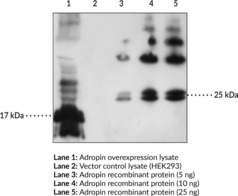
Adropin is a 76 amino acid secreted peptide expressed in the brain, liver, and plasma and is encoded by the energy homeostasis associated gene.1 It is very highly conserved in mammals, and is involved in glucose homeostasis and lipid metabolism.1 Plasma levels of adropin decrease with age and have been associated with metabolic disorders such as dyslipidemia and insulin resistance.2 Adropin is involved in post-
WARNING This product is not for human or veterinary use.
References & Product Citations
1. Identification of adropin as a secreted factor linking dietary macronutrient intake with energy homeostasis and lipid metabolism. Cell Metab. 8(6), 468-481 (2008).
2. Low circulating adropin concentrations with obesity and aging correlate with risk factors for metabolic disease and increase after gastric bypass surgery in humans. J. Clin. Endocrinol. Metab. 97(10), 3783-3791 (2012).
3. Adropin is a novel regulator of endothelial function. Circulation 122(Suppl 11), S185-S192 (2010).
Contact Info
Cayman Chemical1180 East Ellsworth RoadAnn Arbor, Michigan 48108 USAToll Free: (800) 364-9897(USA and Canada only)Fax: (734) 971-3640


