
Technical Support & Resources
Visit our FAQ
Contact Us
Toll Free Phone (USA and Canada Only): (888) 526-5351
Direct Phone: (734) 975-3888
Product Categories
Research Area
Cytokeratin Monoclonal PE Antibody (Clone C-11)
Item No. 10478
Technical Information
- CKs
- pan-Cytokeratin
- Keratin
Shipping & Storage Information
Recommended Products
Certificates of Analysis & Batch Specific Data
Provide batch numbers separated by commas to download or request available product inserts, QC sheets, certificates of analysis, data packs, and GC-MS data.
Product Description
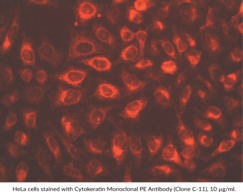
Cytokeratins (CKs) are intermediate filaments proteins and members of the cytokeratin protein family.1,2,3 The cytokeratin family is composed of at least 20 unique gene products, which fall into two categories: type I acidic cytokeratins, CK9-CK20, and type II neutral-basic cytokeratins, CK1-CK8.2 Each cytokeratin is composed of a central rod containing four α-helical domains, which are important for self-assembly, and non-helical head and tail domains at the N- and C-termini, respectively.2,3 Cytokeratins are major structural proteins expressed in epithelial cells and localized to the cytoplasm where they form heterozygous type I-type II pairs.1,4 They primarily function to protect epithelial cells from mechanical and non-mechanical stresses that induce cell rupture and death.5 Cytokeratins have additional isoform- and tissue-specific functions, including the modulation of protein synthesis and cell size during epithelial growth and roles in skin pigmentation. Cayman’s Cytokeratin Monoclonal PE Antibody (Clone C-11) can be used for flow cytometry (FC) and immunofluorescence (IF) applications. This antibody recognizes cytokeratins 4, 5, 6, 8, 10, 13, and 18 from human samples.
WARNING This product is not for human or veterinary use.
References & Product Citations
1. Biological functions of cytokeratin 18 in cancer. Mol. Cancer Res. 10(4), 485-493 (2012).
2. Keratin function in skin epithelia: A broadening palette with surprising shades. Curr. Opin. Cell Biol. 19(1), 13-23 (2007).
3. Recent insight into intermediate filament structure. Curr. Opin. Cell Biol. 68, 132-143 (2021).
4. Cancer-
5. Coupling of histone deacetylation to NAD breakdown by the yeast silencing protein Sir2: Evidence for acetyl transfer from substrate to an NAD breakdown product. Proc. Natl. Acad. Sci. USA 98(2), 415-420 (2001).
Contact Info
Cayman Chemical1180 East Ellsworth RoadAnn Arbor, Michigan 48108 USAToll Free: (800) 364-9897(USA and Canada only)Fax: (734) 971-3640


