
Technical Support & Resources
Visit our FAQ
Contact Us
Toll Free Phone (USA and Canada Only): (888) 526-5351
Direct Phone: (734) 975-3888
Product Categories
GluR1 (Phospho-Ser845) Polyclonal Antibody
Item No. 10601
Technical Information
- AMPA-selective Glutamate Receptor 1
- GluR-1
- GluR-A
- GluA1
Shipping & Storage Information


Certificates of Analysis & Batch Specific Data
Provide batch numbers separated by commas to download or request available product inserts, QC sheets, certificates of analysis, data packs, and GC-MS data.
Product Description
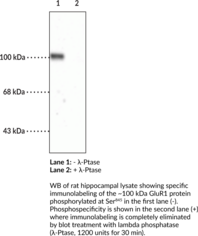
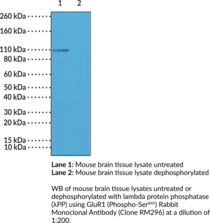
GluR1 is a subunit of the AMPA ionotropic glutamate receptor, which is responsible for fast excitatory synaptic transmission in the CNS.1 AMPA receptors are composed of four subunits, GluR1, GluR2, GluR3, and GluR4, which combine into heterotetramers to form a cation-permeable pore in the plasma membrane. Each subunit has two isoforms with the primary isoform designated as flip and a second isoform generated through alternative splicing designated as flop.2,3 The GluR1 flip and flop isoforms do not affect desensitization or channel opening and closing kinetics.3 GluR1 can be phosphorylated by PKA at serine 845 (Ser845), which increases the peak open probability of the ion channel, and dephosphorylation is required for AMPA receptor endocytosis.1 GluR1 (phospho-Ser845) levels increase in the ventromedial prefrontal cortex (vmPFC) and nucleus accumbens (NAc) following cocaine-cue extinction.4 Levels of GluR1 (phospho-Ser845) are reduced following NMDA receptor activation in rat hippocampal slices and by amyloid-β (Aβ) oligomers in primary mouse neurons.5,6 Cayman’s GluR1 (Phospho-Ser845) Polyclonal Antibody can be used for immunohistochemistry (IHC) and Western blot (WB) applications. The antibody recognizes Glur1 (phosphor-Ser845) at approximately 100 kDa from mouse, rat, and turtle samples.
WARNING This product is not for human or veterinary use.
References & Product Citations
1. Control of GluR1 AMPA receptor function by cAMP-
2. Flip and flop: A cell-
3. Flip and flop: A molecular determinant for AMPA receptor channel opening. Biochemistry 48(17), 3767-3777 (2009).
4. Alterations in expression and phosphorylation of GluA1 receptors following cocaine-
5. Differential regulation of AMPA receptor GluA1 phosphorylation at serine 831 and 845 associated with activation of NMDA receptor subpopulations. Neurosci. Lett. 497(2), 94-98 (2011).
6. Soluble oligomers of amyloid-
Contact Info
Cayman Chemical1180 East Ellsworth RoadAnn Arbor, Michigan 48108 USAToll Free: (800) 364-9897(USA and Canada only)Fax: (734) 971-3640


