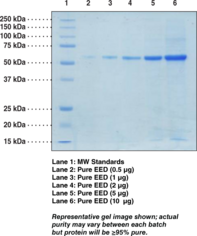
Pure human recombinant protein
Technical Support & Resources

Visit our FAQ

Contact Us

Toll Free Phone (USA and Canada Only): (888) 526-5351
Direct Phone: (734) 975-3888

Request Technical Support

Technical Support Request

To streamline the process attach the appropriate questionnaire to your inquiry.

Download IHC QuestionnaireDownload WB Questionnaire

View Our Privacy Statement for details on how we use and protect your data. In addition, this site is protected by hCaptcha and its Privacy Policy and Terms of Service apply.

EED (human recombinant)

Item No. 10628

Technical Information
Synonyms
  • Embryonic Ectoderm Development
Purity
≥95% estimated by SDS-PAGE
Source
Recombinant N-terminal His-tagged protein, expressed in Sf21 cells using a baculovirus expression system
Amino Acids
1-441 (full-length)
MW
53.5 kDa
UniProt Accession №
O75530
Shipping & Storage Information
Storage
-80°C
Shipping
Dry ice in continental US; may vary elsewhere
Recommended Products

Certificates of Analysis & Batch Specific Data

Provide batch numbers separated by commas to download or request available product inserts, QC sheets, certificates of analysis, data packs, and GC-MS data.

    Add

    Product Description

    The human-Embryonic ectoderm development (EED) protein is a WD40 repeat-containing protein that forms part of the Polycomb repressive complex 2 (PRC2).1,2 The PRC2 core complex contains the catalytic subunit EZH2 (Enhancer of zeste 2), SUZ12 (Suppressor of zeste) and EED. The EED subunit does not contain methyltransferase activity. However, transcriptional repression by PRC2-mediated trimethylation of lysine 27 on Histone H3 (H3K27me3) has been shown to be dependent on EED binding to repressive histone marks.3

    WARNING This product is not for human or veterinary use.

    References & Product Citations
    Product Description References

    1. Schumacher, A., Lichtarge, O., Schwartz, S., et alThe murine polycomb-group gene EED and its human orthologue: Functional implications of evolutionary conservation. Genomics 54, 79-88 (1998).

    2. Suganuma, T., and Workman, J.L. WD40 repeats arrange histone tails for spreading of silencing. J. Mol. Cell Biol. 2(2), 81-83 (2010).

    3. Margueron, R., Justin, N., Ohno, K., et alRole of the polycomb protein EED in the propagation of repressive histone marks. Nature 461, 762-767 (2009).