Active, pure human recombinant enzyme
Technical Support & Resources

Visit our FAQ

Contact Us

Toll Free Phone (USA and Canada Only): (888) 526-5351
Direct Phone: (734) 975-3888

Request Technical Support

Technical Support Request

To streamline the process attach the appropriate questionnaire to your inquiry.

Download IHC QuestionnaireDownload WB Questionnaire

View Our Privacy Statement for details on how we use and protect your data. In addition, this site is protected by hCaptcha and its Privacy Policy and Terms of Service apply.

Gcn5 (human, recombinant)

Item No. 10782

Technical Information
Synonyms
  • General control of amino acid synthesis protein 5-like 2
  • KAT2A
  • Lysine acetyltransferase 2A
  • STAF97
Purity
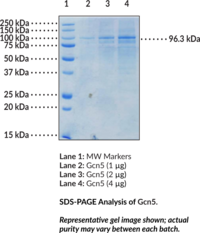
≥50% estimated by SDS-PAGE
Source
Active recombinant N-terminal His-tagged protein expressed in Sf21 cells
Amino Acids
2-837 (full-length)
MW
96.3 kDa
50 mM Tris, pH 8.0, with 150 mM sodium chloride and 20% glycerol
UniProt Accession №
Q92830
Shipping & Storage Information
Storage
-80°C
Shipping
Dry ice in continental US; may vary elsewhere
Recommended Products

Certificates of Analysis & Batch Specific Data

Provide batch numbers separated by commas to download or request available product inserts, QC sheets, certificates of analysis, data packs, and GC-MS data.

    Add

    Product Description

    Gcn5 and PCAF are highly homologous members of the Gcn5-related N-acetyltransferase (GNAT) superfamily of N-acetyltransferases involved in histone acetylation.1 Gcn5 and PCAF contain a highly conserved central core with divergent N- and C-terminal ends.2 Gcn5/PCAF are enzymatic subunits that exist in a mutually exclusive manner as part of the mammalian SAGA and ATAC complexes.3,4 Recombinant Gcn5 preferentially acetylates lysine 14 on histone H3 in vitro. Recombinant Gcn5 alone is unable to acetylate nucleosomal core histone substrates. Acetylation of the nucleosomal histones requires that Gcn5 be a part of either the multisubunit SAGA or ATAC protein complexes.5 The multisubunit Gcn5/PCAF-containing complexes have a broad substrate specificity, including H3K9, H3K18, H4K8, and H4K16, as well as additional sites on histone H2B.3

    WARNING This product is not for human or veterinary use.

    References & Product Citations
    Product Description References

    1. Vetting, M.W., de Carvalho, L.P.S., Yu, M., et alStructure and functions of the GNAT superfamily of acetyltransferases. Arch. Biochem. Biophys. 433(1), 212-226 (2005).

    2. Trievel, R.C., Rojas, J.R., Sterner, D.E., et alCrystal structure and mechanism of histone acetylation of the yeast GCN5 transcriptional coactivator. Proc. Natl. Acad. Sci. USA 96(16), 8931-8936 (1999).

    3. Roth, S.Y., Denu, J.M., and Allis, C.D. Histone acetyltransferases. Annu. Rev. Biochem. 70, 81-120 (2001).

    4. Wang, Y.L., Faiola, F., Xu, M., et alHuman ATAC is a GCN5/PCAF-containing acetylase complex with a novel NC2-like histone fold module that interacts with the TATA-binding protein. The Journal of Biological Chemisty 283(49), 33808-33815 (2008).

    5. Grant, P.A., Sterner, D.E., Duggan, L.J., et alThe SAGA unfolds: Convergence of transcription regulators in chromatin-modifying complexes. Trends Cell Biol. 8(5), 193-197 (1998).