Purified human recombinant enzyme
Technical Support & Resources

Visit our FAQ

Contact Us

Toll Free Phone (USA and Canada Only): (888) 526-5351
Direct Phone: (734) 975-3888

Request Technical Support

Technical Support Request

To streamline the process attach the appropriate questionnaire to your inquiry.

Download IHC QuestionnaireDownload WB Questionnaire

View Our Privacy Statement for details on how we use and protect your data. In addition, this site is protected by hCaptcha and its Privacy Policy and Terms of Service apply.

WDR5 (human, recombinant)

Item No. 10944

Technical Information
Synonyms
  • BIG3
  • BMP2-induced 3-kb Gene Protein
  • SWD3, Set1c WD40 repeat protein, homolog
  • WD-Repeat Protein 5
Purity
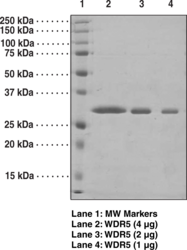
≥95% estimated by SDS-PAGE
Source
recombinant protein expressed in E. coli
Amino Acids
2-334 (full length)
MW
34.4 kDa
50 mM Tris, pH 8.0, with 150 mM sodium chloride and 20% glycerol
License
SUMOpro tag was used under non-exclusive license from LifeSensors, Inc.
Shipping & Storage Information
Storage
-80°C
Shipping
Dry ice in continental US; may vary elsewhere
Recommended Products

Certificates of Analysis & Batch Specific Data

Provide batch numbers separated by commas to download or request available product inserts, QC sheets, certificates of analysis, data packs, and GC-MS data.

    Add

    Product Description

    WD repeats are motifs of approximately 40 amino acids typically terminating in conserved tryptophan and aspartate residues. Several WD40 repeats combine to form the structural WD domain. Such an arrangement facilitates protein-protein interactions allowing the formation of multiprotein complexes.1 Human WDR5 contains seven WD 40 repeats and was originally identified to accelerate osteoblast differentiation.2 WDR5 has been demonstrated to bind histone H3 by recognizing the first three amino acids of the N-terminal tail.3 Binding of WDR5 to a conserved arginine-containing motif in MLL-1, the so-called WDR5 interaction (“Win”) motif, promotes the assembly and activity of the MLL core complex.4 Additional interactions have been demonstrated with other components of the human MLL core protein complex, which includes ASH2L and RbBP5.5,6 MLL1-5 protein complexes catalyze the di- and trimethylation of histone H3 at lysine 4 (H3K4me2/me3), leading to the maintenance of global H3K4 trimethylation.7

    WARNING This product is not for human or veterinary use.

    References & Product Citations
    Product Description References

    1. Neer, E.J., Schmidt, C.J., Nambudripad, R., et alThe ancient regulatory-protein family of WD-repeat proteins. Nature 371(6495), 297-300 (1994).

    2. Gori, G., Divieti, P., and Demay, M.B. Cloning and characterization of a novel WD-40 repeat protein that dramatically accelerates osteoblastic differentiation. The Journal of Biological Chemisty 276(49), 46515-46522 (2001).

    3. Couture, J.F., Collazo, E., and Trievel, R.C. Molecular recognition of histone H3 by the WD40 protein WDR5. Nat. Struct. Mol. Biol. 13(8), 698-703 (2006).

    4. Patel, A., Vought, V.E., Dharmarajan, V., et alA conserved arginine-containing motif crucial for the assembly and enzymatic activity of the mixed lineage leukemia protein-1 core complex. The Journal of Biological Chemisty 283(47), 32162-32175 (2008).

    5. Odho, Z., Southall, S.M., and Wilson, J.R. Characterization of a novel WDR5-binding site that recruits RbBP5 through a conserved motif to enhance methylation of histone H3 lysine 4 by mixed lineage leukemia protein-1. The Journal of Biological Chemisty 285(43), 32967-32976 (2010).

    6. Dou, Y., Milne, T.A., Ruthenburg, A.J., et alRegulation of MLL1 H3K4 methyltransferase activity by its core components. Nat. Struct. Mol. Biol. 13(8), 713-719 (2006).

    7. Wang, P., Lin, C., Smith, E.R., et alGlobal analysis of H3K4 methylation defines MLL family member targets and points to a role for MLL1-mediated H3K4 methylation in the regulation of transcriptional initiation by RNA polymerase II. Mol. Cell Biol. 29(22), 6074-6085 (2009).