
Technical Support & Resources
Visit our FAQ
Contact Us
Toll Free Phone (USA and Canada Only): (888) 526-5351
Direct Phone: (734) 975-3888
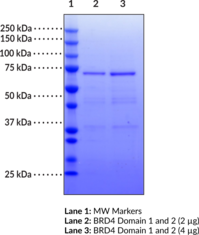

Technical Information
- BRD4
- Bromodomain containing protein 4
- HUNK1
- MCAP
Shipping & Storage Information
Recommended Products
Certificates of Analysis & Batch Specific Data
Provide batch numbers separated by commas to download or request available product inserts, QC sheets, certificates of analysis, data packs, and GC-MS data.

Visit Our Cancer Resource Center
Find Tools & Resources to Study the Hallmarks of Cancer
- Cancer cell signaling & regulation
- Cancer metabolism
- Tumor microenvironment
Product Description
Bromodomain-containing protein 4 (BRD4) is a member of the bromodomain and extra-terminal domain (BET) family.1 It is a ubiquitously expressed nuclear protein with roles in a variety of cellular processes, including regulation of gene transcription, cell cycle progression, and viral genome segregation.1,2 BRD4 is comprised of two N-terminal bromodomains (BD1 and BD2) that can bind to acetylated lysine residues in histones, serving to couple histone acetylation marks to the transcriptional regulation of target promoters, an extra-terminal (ET) domain that facilitates protein-protein interactions, and a C-terminal motif, and can be expressed as either a long or short isoform generated via alternative splicing.1,2,3 In addition to binding acetylated lysine residues on histones, BRD4 can bind to a variety of non-histone proteins and protein complexes, including positive transcription elongation factor b (P-TEFb) and the severe acute respiratory syndrome coronavirus 2 (SARS-CoV-2) envelope (E) protein, a transmembrane protein involved in CoV virion assembly and pathogenesis of the related virus, SARS-CoV.1,4,5,6 In mice, knock-down of Brd4 is embryonic lethal.2 Chromosomal translocations leading to the fusion of BRD4 with the nuclear protein in testis (NUT) gene and resulting in expression of BRD4-NUT fusion proteins are associated with NUT midline carcinoma (NMC).1,3 Inhibition of BRD4-NUT binding to chromatin by the BET bromodomain inhibitor (+)-JQ1 (Item No. 11187) induces tumor regression and prolongs survival in NMC mouse xenograft models.7 Cayman’s BRD4 bromodomains 1 and 2 (human, recombinant; aa 49-460) protein can be used for ELISA, Western blot (WB), and binding assay applications.
WARNING This product is not for human or veterinary use.
References & Product Citations
1. The bromodomain and extra-
2. The double bromodomain-
3. Beating the odds: BETs in disease. Trends Biochem. Sci. 40(8), 468-479 (2015).
4. A SARS-
5. From SARS and MERS CoVs to SARS-
6. Coronavirus envelope protein: Current knowledge. Virol. J. 16(1), 69 (2019).
7. The subunit radioimmunoassay for human chorionic gonadotropin -
Contact Info
Cayman Chemical1180 East Ellsworth RoadAnn Arbor, Michigan 48108 USAToll Free: (800) 364-9897(USA and Canada only)Fax: (734) 971-3640


