
Pure human recombinant protein
Technical Support & Resources

Visit our FAQ

Contact Us

Toll Free Phone (USA and Canada Only): (888) 526-5351
Direct Phone: (734) 975-3888

Request Technical Support

Technical Support Request

To streamline the process attach the appropriate questionnaire to your inquiry.

Download IHC QuestionnaireDownload WB Questionnaire

View Our Privacy Statement for details on how we use and protect your data. In addition, this site is protected by hCaptcha and its Privacy Policy and Terms of Service apply.

Product Categories

Product Type

Application

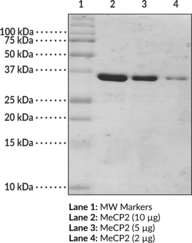
MeCP2 (human recombinant; methyl binding domain aa 77-166)

Item No. 11287
Technical Information
Synonyms
  • Methyl-CpG Binding Protein 2
Purity
≥95%
Source
Recombinant N-terminal GST-tagged protein expressed in E. coli
Amino Acids
77-166 (partial protein)
MW
37 kDa
50 mM Tris, pH 7.5, with 500 mM sodium chloride, 5% glycerol, and 5 mM β-mercaptoethanol
UniProt Accession №
P51608
Shipping & Storage Information
Storage
-80°C
Shipping
Dry ice in continental US; may vary elsewhere
Recommended Products

Certificates of Analysis & Batch Specific Data

Provide batch numbers separated by commas to download or request available product inserts, QC sheets, certificates of analysis, data packs, and GC-MS data.

    Add

    Product Description

    DNA methylation occurs mainly at the 5’-position of cytosine rings (5-methylcytosine (5mC)). The 5mC bases are found largely in genomic regions with a high frequency of cytosines and guanines, called CpG islands. Methyl-CpG binding protein 2 (MeCP2) specifically binds to methylated promoters on CpG islands and mediates gene silencing by recruiting corepressor complexes.1 The Methyl-CpG Binding Domain (MBD) protein family consists of five members: MeCP2, MBD1, MBD2, MBD3 and MBD4.2,3,4 The sequence similarity between the MBD proteins is limited to the MBD domains.5 In vitro work suggests high affinity binding of MeCP2 is facilitated by DNA fragments containing A/T bases ([A/T]≥4) adjacent to the methyl-CpG.6 Mutations in the MeCP2 gene have been linked to the X-linked neurological disorder, Rett Syndrome.7

    WARNING This product is not for human or veterinary use.

    References & Product Citations
    Product Description References

    1. Ho, K.L., McNae, I.W., Schmiedeberg, L., et alMeCP2 binding to DNA depends upon hydration at methyl-CpG. Mol. Cell 29(4), 525-531 (2008).

    2. Fatemi, M., and Wade, P.A. MBD family proteins: Reading the epigenetic code. J. Cell Sci. 119(Pt. 15), 3033-3037 (2006).

    3. Dhasarathy, A., and Wade, P.A. The MBD protein family-reading an epigenetic mark? Mutat. Res. 647(1-2), 39-43 (2008).

    4. Hendrich, B., and Bird, A. Identification and characterization of a family of mammalian methyl-CpG binding proteins. Mol. Cell. Biol. 18(11), 6538-6547 (1998).

    5. Berger, J., and Bird, A. Role of MBD2 in gene regulation and tumorigenesis. Biochem. Soc. Trans. 33(Pt. 6), 1537-1540 (2005).

    6. Klose, R.J., Sarraf, S.A., Schmiedeberg, L., et alDNA binding selectivity of MeCP2 due to a requirement for A/T sequences adjacent to methyl-CpG. Mol. Cell 19(5), 667-678 (2005).

    7. Zachariah, R.M., and Rastegar, M. Linking epigenetics to human disease and Rett Syndrome: The emerging novel and challenging concepts in MeCP2 research. Neural Plast. 415825 (2012).

