
Pure human recombinant protein
Features
  • Due to limited shelf life and/or restricted production, this product is available as custom order only. Please contact our sales office for pricing and lead time.
  • Cayman’s BRDT bromodomain 1 TR-FRET Assay Kit (Item No. 600650) was developed using BRDT bromodomain 1 (human recombinant) protein
  • Bulk sizes available upon request
Technical Support & Resources

Visit our FAQ

Contact Us

Toll Free Phone (USA and Canada Only): (888) 526-5351
Direct Phone: (734) 975-3888

Request Technical Support

Technical Support Request

To streamline the process attach the appropriate questionnaire to your inquiry.

Download IHC QuestionnaireDownload WB Questionnaire

View Our Privacy Statement for details on how we use and protect your data. In addition, this site is protected by hCaptcha and its Privacy Policy and Terms of Service apply.

BRDT bromodomain 1 (human, recombinant)

Item No. 11548
Technical Information
Synonyms
  • BRD6
  • Bromodomain testis-specific protein
  • Cancer/testis antigen 9
  • CT9
  • RING3-like protein
Purity
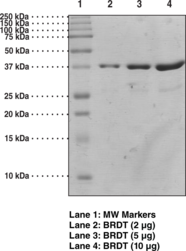
≥80% estimated by SDS-PAGE
Source
recombinant N-terminal GST-tagged protein expressed in E. coli
Amino Acids
21-137 (partial protein)
MW
40.6 kDa
50 mM Tris, pH 7.5, containing 500 mM sodium chloride, 5% glycerol, and 5 mM β-mercaptoethanol
UniProt Accession №
Q58F21
Shipping & Storage Information
Storage
-80°C
Shipping
Dry ice in continental US; may vary elsewhere
Recommended Products

Certificates of Analysis & Batch Specific Data

Provide batch numbers separated by commas to download or request available product inserts, QC sheets, certificates of analysis, data packs, and GC-MS data.

    Add

    Product Description

    Key Features

    • Cayman’s BRDT bromodomain 1 TR-FRET Assay Kit (Item No. 600650) was developed using BRDT bromodomain 1 (human, recombinant) protein.
    • Bulk sizes available upon request
    The acetylation of histone lysine residues plays a crucial role in the epigenetic regulation of gene transcription. Acetylated lysine residues are recognized by a small protein domain known as a bromodomain.1 These domains function in the linking of protein complexes to acetylated nucleosomes, thereby controlling chromatin structure and gene expression. Thus, bromodomains serve as “readers” of histone acetylation marks regulating the transcription of target promoters.2 The BET family of proteins, defined by tandem Bromodomains and an Extra Terminal domain, include BRD2, BRD3, BRD4, and BRDT.3 The BET proteins play a key role in many cellular processes, including inflammatory gene expression, mitosis, and viral/host interactions.4,5,6 BRDT is similar to the RING3 protein family and possesses 2 bromodomain motifs and a PEST sequence motif, which is a region rich in proline (P), glutamic acid (E), serine (S), and threonine (T) residues known to have a short intracellular half-life. This product contains the bromodomain 1 region of BRDT.

    WARNING This product is not for human or veterinary use.

    References & Product Citations
    Product Description References

    1. Mujtaba, S., Zeng, L., and Zhou, M.-M. Structure and acetyl-lysine recognition of the bromodomain. Oncogene 26(37), 5521-5527 (2007).

    2. Muller, S., Filippakopoulos, P., and Knapp, S. Bromodomains as therapeutic targets. Expert Rev. Mol. Med. 13, e29 (2011).

    3. Florence, B., and Faller, D.V. You bet-cha: A novel family of transcriptional regulators. Front. Biosci. 6, D1008-D1018 (2011).

    4. Hargreaves, D.C., Horng, T., and Medzhitov, R. Control of inducible gene expression by signal-dependent transcriptional elongation. Cell 138(1), 129-145 (2009).

    5. LeRoy, G., Rickards, B., and Flint, S.J. The double bromodomain proteins Brd2 and Brd3 couple histone acetylation to transcription. Mol. Cell 30(1), 51-60 (2008).

    6. Weidner-Glunde, M., Ottinger, M., and Schulz, T.F. WHAT do viruses BET on? Front. Biosci. (Landmark Ed.) 15, 537-549 (2010).

    Product Citations

    Zolotarjova, N.I., and Wynn, R. Binding assays for bromodomain proteins: Their utility in drug discovery in oncology and inflammatory disease. Curr. Protoc. Pharm. 80(1), 3.16.11-13.16.14 (2018).

