
Technical Support & Resources
Information provided in the product description is from published literature. Due to the nature of scientific experimentation, your results (e.g., selectivity and effective concentrations) or specific application for this product may differ. If you have questions about how this product fits your application, please contact our technical support staff.
Visit our FAQ
Contact Us
Toll Free Phone (USA and Canada Only): (888) 526-5351
Direct Phone: (734) 975-3888
Technical Information
- Alprostadil
- NSC 165559
- PGE1
Shipping & Storage Information
Recommended Products

Certificates of Analysis & Batch Specific Data
Provide batch numbers separated by commas to download or request available product inserts, QC sheets, certificates of analysis, data packs, and GC-MS data.
Lipid Resource Center
Discover Products & Resources for Lipid Research
- High-purity lipid standards
- Lipid roles in biology
- Lipids in health & disease
- Lipids for pharmaceutical development
- Protocols, advice, & resources
Product Description
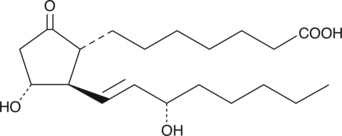
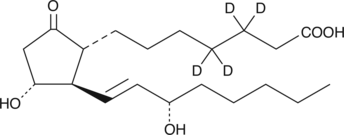
Prostaglandin E1 (PGE1) is a vasoactive prostaglandin and an active metabolite of dihomo-γ-linolenic acid (DGLA; Item No. 90230).1,2 It is formed from DGLA by COX-1 and COX-2. PGE1 is an agonist of the PGE2 (Item No. 14010) receptor subtypes EP1, EP2, EP3, and EP4, and the IP receptor (Kis = 36, 10, 1.1, 2.1, and 33 nM, respectively, for the mouse receptors).3 It inhibits ADP-induced platelet aggregation of isolated human platelet-rich plasma (IC50 = 40 nM) and isoproterenol-induced increases in L-type calcium current (ICa) in isolated rabbit atrial cells (EC50 = 27 nM).4,5 PGE1 (100 nM) induces vasodilation in isolated rat aortic rings and activates ATP-sensitive potassium channels (KATP) in a cell-attached patch clamp assay using isolated rat vascular smooth muscle cells (VSMCs).1 It decreases femoral arterial perfusion pressure in dogs.6 Formulations containing PGE1 have been used in the treatment of erectile dysfunction and to maintain patency of the ductus arteriosus in neonates with congenital heart defects who depend on a patent ductus arteriosus for survival.
WARNING This product is not for human or veterinary use.
References & Product Citations
1. Effects of prostaglandin E1 on vascular ATP-
2. Differential metabolism of dihomo-
3. Ligand binding specificities of the eight types and subtypes of the mouse prostanoid receptors expressed in Chinese hamster ovary cells. Br. J. Pharmacol. 122(2), 217-224 (1997).
4. Antiaggregating potency of E-
5. EP receptor-
6. Relationship between the chemical structure of prostaglandins and their vasoactivities in dogs. Br. J. Pharmacol. 44(1), 63-70 (1972).
Analytical strategy for oxylipin annotation by combining chemical derivatization-
Pharmacological profile of difamilast, a novel selective phosphodiesterase 4 inhibitor, for topical treatment of atopic dermatitis. J. Pharmacol. Exp. Ther. 386(1), 45-55 (2023).
Lipid storm within the lungs of severe COVID-
PGH1, the precursor for the anti-
Contact Info
Cayman Chemical1180 East Ellsworth RoadAnn Arbor, Michigan 48108 USAToll Free: (800) 364-9897(USA and Canada only)Fax: (734) 971-3640


