
Technical Support & Resources
Information provided in the product description is from published literature. Due to the nature of scientific experimentation, your results (e.g., selectivity and effective concentrations) or specific application for this product may differ. If you have questions about how this product fits your application, please contact our technical support staff.
Visit our FAQ
Contact Us
Toll Free Phone (USA and Canada Only): (888) 526-5351
Direct Phone: (734) 975-3888
Technical Information
Shipping & Storage Information
Recommended Products
Certificates of Analysis & Batch Specific Data
Provide batch numbers separated by commas to download or request available product inserts, QC sheets, certificates of analysis, data packs, and GC-MS data.
Kinase Resource Center
Discover Products & Resources for Kinase Research
- Kinase inhibitors, screening libraries, assay kits, & more
- Tools to study kinase signaling pathways:
- Growth factor signaling
- PI3K/Akt/mTOR
- MAPKs (ERK, p38, & JNK)
- JAK/STAT signaling
- Articles, resources, & advice
Product Description
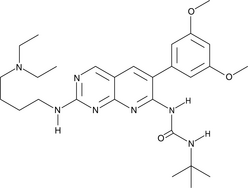
The fibroblast growth factor receptors (FGFRs) are cell surface receptors with intrinsic tyrosine kinase activity, which is necessary for receptor activation and signal propagation. PD 173074 is a potent and selective inhibitor of FGFR tyrosine kinase activity, blocking autophosphorylation of FGFR1 with an IC50 value of 21.5 nM.1 For comparison, it weakly inhibits PDGFR and c-
WARNING This product is not for human or veterinary use.
References & Product Citations
1. Crystal structure of an angiogenesis inhibitor bound to the FGF receptor tyrosine kinase domain. EMBO J. 17(20), 5896-5904 (1998).
2. The FGFR1 inhibitor PD 173074 selectively and potently antagonizes FGF-
3. Blocking of FGFR signaling inhibits breast cancer cell proliferation through downregulation of D-
4. Targeting FGFR3 in multiple myeloma: inhibition of t(4;14)-
5. Fibroblast growth factor receptors as molecular targets in thyroid carcinoma. Endocrinology 146(3), 1145-1153 (2005).
6. A discrete period of FGF-
7. FGF stimulation of the Erk1/2 signalling cascade triggers transition of pluripotent embryonic stem cells from self-
8. Autocrine fibroblast growth factor 2 signaling is critical for self-
Contact Info
Cayman Chemical1180 East Ellsworth RoadAnn Arbor, Michigan 48108 USAToll Free: (800) 364-9897(USA and Canada only)Fax: (734) 971-3640


