
Technical Support & Resources
Visit our FAQ
Contact Us
Toll Free Phone (USA and Canada Only): (888) 526-5351
Direct Phone: (734) 975-3888
Product Categories
Technical Information
- H3
Shipping & Storage Information
Recommended Products
Certificates of Analysis & Batch Specific Data
Provide batch numbers separated by commas to download or request available product inserts, QC sheets, certificates of analysis, data packs, and GC-MS data.

Visit Our Cancer Resource Center
Find Tools & Resources to Study the Hallmarks of Cancer
- Cancer cell signaling & regulation
- Cancer metabolism
- Tumor microenvironment
Product Description
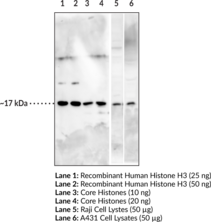
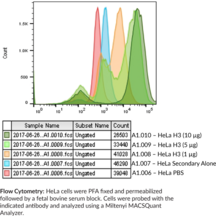
Histone H3 is a nuclear protein and a component of the nucleosome core, a basic unit of chromatin, that is essential for organizing genomic DNA in eukaryotic nuclei.1 It is a globular protein that contains an unstructured N-terminal tail that extends outside of the nucleosome core and is subject to various post-translational modifications (PTMs), including methylation, phosphorylation, acetylation, and citrullination.1,2 Histone H3 PTMs function as epigenetic regulators of gene transcription by affecting chromatin structure and providing binding sites for many transcription factors, thus regulating several cellular functions including gene expression, cell cycle, and DNA replication and repair.1,3 Differential methylation of histone H3 at various lysine residues is catalyzed by SET domain-containing methyltransferases and marks sites of transcriptional activation or repression.1 Citrullination of histone H3 by protein arginine deiminase 4 (PAD4; Item Nos. 10500 | 25915 | 28910) or PAD2 (Item No. 10785) induces the release of neutrophil extracellular traps (NETs), a network of decondensed DNA and intracellular proteins secreted by neutrophils as a pathogen defense mechanism.4,5 Histone H3 mutations have been found in patients with diffuse intrinsic pontine glioma, leukemia, or chondroblastoma.6,7 Cayman's Histone H3 Polyclonal Antibody can be used for ELISA, flow cytometry (FC), immunoprecipitation (IP), and Western blot (WB) applications. The antibody recognizes histone H3 at 15.5 kDa from human samples.
WARNING This product is not for human or veterinary use.
References & Product Citations
1. Writing, erasing and reading histone lysine methylations. Exp. Mol. Med. 49(4), e324 (2017).
2. Histone posttranslational modifications: Potential role in diagnosis, prognosis, and therapeutics of cancer. Prognostic Epigenetics 15, 351-373 (2019).
3. Histone H3 variants and their chaperones during development and disease: Contributing to epigenetic control. Annu. Rev. Cell Dev. Biol. 30, 615-646 (2014).
4. PAD4 mediated histone hypercitrullination induces heterochromatin decondensation and chromatin unfolding to form neutrophil extracellular trap-
5. Inhibition of peptidylarginine deiminase alleviates LPS-
6. Histone H3 mutations: An updated view of their role in chromatin deregulation and cancer. Cancers (Basel) 11(5), 660 (2019).
7. Histone H3 mutations in cancer. Curr. Pharmacol. Rep. 4(4), 292-300 (2018).
Evidence for a direct link between PAD4-
Contact Info
Cayman Chemical1180 East Ellsworth RoadAnn Arbor, Michigan 48108 USAToll Free: (800) 364-9897(USA and Canada only)Fax: (734) 971-3640


