A primary COX product of arachidonic acid
Technical Support & Resources

Information provided in the product description is from published literature. Due to the nature of scientific experimentation, your results (e.g., selectivity and effective concentrations) or specific application for this product may differ. If you have questions about how this product fits your application, please contact our technical support staff.

Visit our FAQ

Contact Us

Toll Free Phone (USA and Canada Only): (888) 526-5351
Direct Phone: (734) 975-3888

Request Technical Support

Technical Support Request

To streamline the process attach the appropriate questionnaire to your inquiry.

Download IHC QuestionnaireDownload WB Questionnaire

View Our Privacy Statement for details on how we use and protect your data. In addition, this site is protected by hCaptcha and its Privacy Policy and Terms of Service apply.

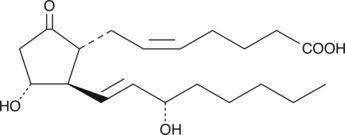
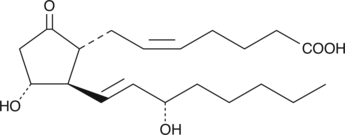
Prostaglandin E2

Item No. 14010

Technical Information
Formal Name
9-oxo-11α,15S-dihydroxy-prosta-5Z,13E-dien-1-oic acid
CAS Number
363-24-6
Synonyms
  • Dinoprostone
  • PGE2
Molecular Formula
C20H32O5
Formula Weight
Purity
≥98%
A crystalline solid
DMF: >100 mg/mlDMSO: >100 mg/mlEthanol: >100 mg/mlPBS (pH 7.2): 5 mg/ml
SMILES
O=C1[C@H](C/C=C\CCCC(O)=O)[C@@H](/C=C/[C@@H](O)CCCCC)[C@H](O)C1
InChi Code
InChI=1S/C20H32O5/c1-2-3-6-9-15(21)12-13-17-16(18(22)14-19(17)23)10-7-4-5-8-11-20(24)25/h4,7,12-13,15-17,19,21,23H,2-3,5-6,8-11,14H2,1H3,(H,24,25)/b7-4-,13-12+/t15-,16+,17+,19+/m0/s1
InChi Key
XEYBRNLFEZDVAW-ARSRFYASSA-N
Origin
Synthetic
Shipping & Storage Information
Storage
-20°C
Shipping
Wet ice in continental US; may vary elsewhere
Recommended Products

Certificates of Analysis & Batch Specific Data

Provide batch numbers separated by commas to download or request available product inserts, QC sheets, certificates of analysis, data packs, and GC-MS data.

    Add

    Add

    Add

    Add

    Lipid Resource Center
    Discover Products & Resources for Lipid Research
    • High-purity lipid standards
    • Lipid roles in biology
    • Lipids in health & disease
    • Lipids for pharmaceutical development
    • Protocols, advice, & resources
    EXPLORE NOW
    Product Description

    PGE2 is one of the primary COX products of arachidonic acid (Item No. 90010) and one of the most widely investigated prostaglandins. Its activity influences inflammation, fertility and parturition, gastric mucosal integrity, and immune modulation.1,2,3,4 The effects of PGE2 are transduced by at least four distinct receptors designated EP1, EP2, EP3, and EP4.5 Affinity constants (Kd) of PGE2 for these receptors range from 1-10 nM depending on the receptor subtype and tissue.

    WARNING This product is not for human or veterinary use.

    References & Product Citations
    Product Description References

    1. Willis, A.L., and Cornelsen, M. Repeated injection of prostaglandin E2 in rat paws induces chronic swelling and a marked decrease in pain threshold. Prostaglandins 3(3), 353-357 (1973).

    2. Jackson, G.M., Sharp, H.T., and Varner, M.W. Cervical ripening before induction of labor: A randomized trial of prostaglandin E2 gel versus low-dose oxytocin. Am. J. Obstet. Gynecol. 171(4), 1092-1096 (1994).

    3. Robert, A., Schultz, J.R., Nezamis, J.E., et alGastric antisecretory and antiulcer properties of PGE2, 15-methyl PGE2, and 16,16-dimethyl PGE2. Intravenous, oral and intrajejunal administration. Gastroenterology 70(3), 359-370 (1976).

    4. Arvind, P., Papavassiliou, E.D., Tsioulias, G.J., et alProstaglandin E2 down-regulates the expression of HLA-DR antigen in human colon adenocarcinoma cell lines. Biochemistry 34(16), 5604-5609 (1995).

    5. Coleman, R.A., Smith, W.L., and Narumiya, S. International Union of Pharmacology classification of prostanoid receptors: Properties, distribution, and structure of the receptors and their subtypes. Pharmacol. Rev. 46(2), 205-229 (1994).

    Product Citations

    Yang, J., Yamashita-Kanemaru, Y., Morris, B.I., et alAspirin prevents metastasis by limiting platelet TXA2 suppression of T cell immunity. Nature (2025).

    Wang, Y.X., Palla, A.R., Ho, A.T.V., et alMultiomic profiling reveals that prostaglandin E2 reverses aged muscle stem cell dysfunction, leading to increased regeneration and strength. Cell Stem Cell 32, 1154-1169 (2025).

    Wu, Z., Xiao, H., Rao, D., et alAnalytical strategy for oxylipin annotation by combining chemical derivatization-based retention index algorithm and feature tandem mass spectrometric fragmentation as a biomarker discovery tool. Anal. Chem. 95(43), 15933-15942 (2023).

    Pang, Y., Liu, X., Zhao, C., et alLC-MS/MS-based arachidonic acid metabolomics in acute spinal cord injury reveals the upregulation of 5-LOX and COX-2 products. Free Radic. Biol. Med. 193(Pt 1), 363-372 (2022).

    Archambault, A.-S., Brassard, J., Bernatchez, É., et alHuman and mouse eosinophils differ in their ability to biosynthesize eicosanoids, docosanoids, the endocannabinoid 2-arachidonoyl-glycerol and its congeners. Cells 11(1), 141 (2022).

    Gurusamy, M., Nasseri, S., Rampa, D.R., et alInhibition of microsomal prostaglandin E synthase-1 ameliorates acute lung injury in mice. J. Transl. Med. 19(1), 340 (2021).

    Archambault, A.-S., Zaid, Y., Rakotoarivelo, V., et alHigh levels of eicosanoids and docosanoids in the lungs of intubated COVID-19 patients. FASEB J. 35(6), e21666 (2021).

    Roberts, L.M., Schwarz, B., Speranza, E., et alPulmonary infection induces persistent, pathogen-specific lipidomic changes influencing trained immunity. iScience 24(9), 103025 (2021).

    Wang, Y., Cui, L., Georgiev, P., et alCombination of EP4 antagonist MF-766 and anti-PD-1 promotes anti-tumor efficacy by modulating both lymphocytes and myeloid cells. Oncoimmunology 10(1), 1896643 (2021).

    Hartling, I., Cremonesi, A., Osuna, E., et alQuantitative profiling of inflammatory and pro-resolving lipid mediators in human adolescents and mouse plasma using UHPLC-MS/MS. Clin. Chem. Lab. Med. 59(11), 1811-1823 (2021).

    Archambault, A.-S., Zaid, Y., Rakotoarivelo, V., et alLipid storm within the lungs of severe COVID-19 patients: Extensive levels of cyclooxygenase and lipoxygenase-derived inflammatory metabolites. medRxiv (2020).

    Endo, S., Suganami, A., Fukushima, K., et al15-Keto-PGE2 acts as a biased/partial agonist to terminate PGE2-evoked signaling. The Journal of Biological Chemisty 295(38), 13338-13352 (2020).

    Brouwers, H., Jónasdóttir, H.S., Kuipers, M.E., et alAnti-inflammatory and proresolving effects of the omega-6 polyunsaturated fatty acid adrenic acid. J. Immunol. 205(10), 2840-2849 (2020).

    Schmidleithner, L., Thabet, Y., Schönfeld, E., et alEnzymatic activity of HPGD in Treg cells suppresses Tconv cells to maintain adipose tissue homeostasis and prevent metabolic dysfunction. Immunity 50(5), 1232-1248 (2019).

    Meriwether, D., Sulaiman, D., Volpe, C., et alApolipoprotein A-I mimetics mitigate intestinal inflammation in COX2-dependent inflammatory bowel disease model. J. Clin. Invest. 130, 3670-3685 (2019).

    Allain, E.P., Rouleau, M., Le, T., et alIn activation of prostaglandin E2 as a mechanism for UGT2B17-mediated adverse effects in chronic lymphocytic leukemia. Front. Oncol. 9:606, (2019).

    Saldaña, L., Bensiamar, F., Vallés, G., et alImmunoregulatory potential of mesenchymal stem cells following activation by macrophage-derived soluble factors. Stem Cell Res. Ther. 10(1), 58 (2019).

    Dalli, J., Colas, R.A., Walker, M.E., et alLipid Mediator Metabolomics via LC-MS/MS Profiling and Analysis. Clinical Metabolomics 59-72 (2018).

    Sorgi, C.A., Peti, A.P.F., Petta, T., et alComprehensive high-resolution multiple-reaction monitoring mass spectrometry for targeted eicosanoid assays. Sci. Data 5, 180167 (2018).

    Meurer, M., Ebert, K., Schweda, K., et alThe renal vasodilatory effect of prostaglandins is ameliorated in isolated-perfused kidneys of endotoxemic mice. Pflugers Arch. 470(11), 1691-1703 (2018).

    Chen, I.-J., Hee, S.-W., Liao, C.-H., et alTargeting the 15-keto-PGE2-PTGR2 axis modulates systemic inflammation and survival in experimental sepsis. Free Radic. Biol. Med. 115, 113-126 (2018).

    Hennebelle, M., Zhang, M., Metherel, A.H., et alLinoleic acid participates in the response to ischemic brain injury through oxidized metabolites that regulate neurotransmission. Sci. Rep. 7(4342), (2017).

    Venerito, M., Helmke, C., Jechorek, D., et alLeukotriene receptor expression in esophageal squamous cell cancer and non-transformed esophageal epithelium: a matched case control study. BMC Gastroenterol. 16(1), 85 (2016).

    Suganami, A., Fujino, H., Okura, I., et alHuman DP and EP2 prostanoid receptors take on distinct forms depending on the diverse binding of different ligands. FEBS J. 283(21), 3931-3940 (2016).

    Sasaki, A., Fukuda, H., Shiida, N., et alDetermination of ω-6 and ω-3 PUFA metabolites in human urine samples using UPLC/MS/MS. Anal. Bioanal. Chem. 407(6), 1625-1639 (2015).

    Otake, S., Yoshida, K., Seira, N., et alCellular density-dependent fown-regulation of EP4 prostanoid receptors via the up-regulation of hypoxia-inducible factor-1a in HCA-7 human colon cancer cells. Pharm. Res. Prespect. 3(1), e00083 (2014).

    Whittle, B.J., Silverstein, A.M., Mottola, D.M., et alBinding and activity of the prostacyclin receptor (IP) agonists, treprostinil and iloprost, at human prostanoid receptors: Treprostinil is a potent DP1 and EP2 agonist. Biochem. Pharmacol. 84(1), 68-75 (2012).

    Qi, H.-Y., Daniels, M.P., Liu, Y., et alA cytosolic phospholipase A2-initiated lipid mediator pathway induces autophagy in macrophages. J. Immunol. 187(10), 5286-5292 (2011).

    Wobst, I., Schiffmann, S., Birod, K., et alDimethylcelecoxib inhibits prostaglandin E2 production. Biochem. Pharmacol. 76(1), 62-69 (2008).

    George, R.J., Sturmoski, M.A., Anant, S., et alEP4 mediates PGE2 dependent cell survival through the PI3 kinase/AKT pathway. Prostaglandins Other Lipid Mediat. 83(1-2), 112-120 (2007).

    Fujino, H., and Regan, J.W. EP4 prostanoid receptor coupling to a pertussis toxin-sensitive inhibitory G protein. Mol. Pharm. 69(1), 5-10 (2006).

    Eligini, S., Violi, F., Banfi, C., et alIndobufen inhibits tissue factor in human monocytes through a thromboxane-mediated mechanism. Cardiovasc. Res. 69(1), 218-226 (2006).

    Zhong, H., Willard, M., and Simons, J. NS398 reduces hypoxia-inducible factor (HIF)-1a and HIF-1 activity: Multiple-level effects involving cyclooxygenase-2 dependent and independent mechanisms. Int. J. Cancer 112, 585-595 (2004).

    Woodward, D.F., Krauss, A.H.P., Chen, J., et alPharmacological characterization of a novel antiglaucoma agent, bimatoprost (AGN 192024). J. Pharmacol. Exp. Ther. 305(2), 772-785 (2003).

    Levy, B.D., De Sanctis, G.T., Devchand, P.R., et alMulti-pronged inhibition of airway hyper-responsiveness and inflammation by lipoxin A4. Nat. Med. 8(9), 1018-1023 (2002).

    Rao, C.V., Desai, D., Rivenson, A., et alChemoprevention of colon carcinogenesis by phenylethyl-3-methylcaffeate. Cancer Res. 55(11), 2310-2315 (1995).