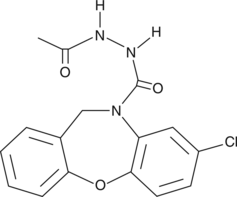
A selective EP1 receptor antagonist
Technical Support & Resources

Visit our FAQ

Contact Us

Toll Free Phone (USA and Canada Only): (888) 526-5351
Direct Phone: (734) 975-3888

Request Technical Support

Technical Support Request

To streamline the process attach the appropriate questionnaire to your inquiry.

Download IHC QuestionnaireDownload WB Questionnaire

View Our Privacy Statement for details on how we use and protect your data. In addition, this site is protected by hCaptcha and its Privacy Policy and Terms of Service apply.

SC-19220

Item No. 14060

Technical Information
Formal Name
8-chloro-dibenz[b,f][1,4]oxazepine-10(11H)-carboxy-(2-acetyl)hydrazide
CAS Number
19395-87-0
Molecular Formula
C16H14ClN3O3
Formula Weight
Purity
≥96%
Formulation
A crystalline solid
DMF: >25 mg/mlDMSO: >14 mg/mlDMSO:PBS (1:2): 300 µg/mlEthanol: <20 µg/mlPBS pH 7.2: <20 µg/ml
λmax
203 nm
SMILES
CC(=O)NNC(=O)N1Cc2ccccc2Oc2ccc(Cl)cc12
InChi Code
InChI=1S/C16H14ClN3O3/c1-10(21)18-19-16(22)20-9-11-4-2-3-5-14(11)23-15-7-6-12(17)8-13(15)20/h2-8H,9H2,1H3,(H,18,21)(H,19,22)
InChi Key
KNURFLJTOUGOOQ-UHFFFAOYSA-N
Shipping & Storage Information
Storage
-20°C
Shipping
Room temperature in continental US; may vary elsewhere
Recommended Products

Certificates of Analysis & Batch Specific Data

Provide batch numbers separated by commas to download or request available product inserts, QC sheets, certificates of analysis, data packs, and GC-MS data.

    Add

    Add

    Add

    Lipid Resource Center
    Discover Products & Resources for Lipid Research
    • High-purity lipid standards
    • Lipid roles in biology
    • Lipids in health & disease
    • Lipids for pharmaceutical development
    • Protocols, advice, & resources
    EXPLORE NOW
    Product Description

    SC-19220 is a dibenzoxazepine that acts as a selective antagonist of PGE2 at the EP1 receptor.1,2 At doses between 0.3-300 µM, SC-19220 acts as a competitive antagonist of PGE2-induced smooth muscle contractions of guinea pig ileum and stomach.3,4 SC-19220 also acts as a PGE2 antagonist in the EP1 receptor-mediated contraction of guinea pig trachea.5 SC-19220 displaces radiolabeled PGE2 from the cloned human EP1 receptor with an IC50 of 6.7 µM and exhibits no binding at the human EP2 receptor.6,7 It binds with apparent low affinity to the cloned mouse EP1 receptor expressed in CHO cells.8 In a model of bone resorption, 3-150 μM SC-19220 inhibited both 1,25 dihydroxy vitamin D3- and PGE2-stimulated osteoclastogenesis in mouse osteoclast precursors.9 Antagonism of EP1 with 1 μM SC-19220 has been shown to promote metastasis in a mouse model of metastatic breast cancer.10 In a rodent model of Parkinson’s disease, 1.5 μM SC-19220 prevented PGE2-mediated loss of dopaminergic neurons from rat substantia nigra.11

    WARNING This product is not for human or veterinary use.

    References & Product Citations
    Product Description References

    1. Coleman, R.A., Eglen, R.M., Jones, R.L., et alClassification of prostanoid receptors IUPHAR receptor compendium. IUPHAR Compendium 1-12 (1997).

    2. Zeng, L., An, S., and Goetzl, E.J. Selective regulation of RNK-16 cell matrix metalloproteinases by the EP4 subtype of prostaglandin E2 receptor. Biochemistry 35, 7159-7164 (1996).

    3. Rakovska, A., and Milenov, K. Antagonistic effect of SC-19220 on the responses of guinea-pig gastric muscles to prostaglandins E1, E2, and F. Arch. Int. Pharmacodyn Ther. 268, 59-69 (1984).

    4. Sanner, J. Prostaglandin Inhibition with a dibenzoxazepine hydrazide derivative and morphine. Ann. N. Y. Acad. Sci. 180, 396-409 (1971).

    5. Coleman, R.A., and Kennedy, I. Characterisation of the prostanoid receptors mediating contraction of guinea-pig isolated trachea. Prostaglandins 29, 363-375 (1985).

    6. Funk, C.D., Furci, L., Fitzgerald, G.A., et alCloning and expression of a cDNA for the human prostaglandin E receptor EP1 subtype. The Journal of Biological Chemisty 268(35), 26767-26772 (1993).

    7. Bastien, L., Sawyer, N., Grygorczyk, R., et alCloning, functional expression, and characterization of the human prostaglandin E2 receptor EP2 subtype. The Journal of Biological Chemisty 269(16), 11873-11877 (1994).

    8. Kiriyama, M., Ushikubi, F., Kobayashi, T., et alLigand binding specificities of the eight types and subtypes of the mouse prostanoid receptors expressed in Chinese hamster ovary cells. Br. J. Pharmacol. 122(2), 217-224 (1997).

    9. Inoue, H., Tsujisawa, T., Fukuizumi, T., et alSC-19220, a prostaglandin E2 antagonist, inhibits osteoclast formation by 1,25-dihydroxyvitamin D3 in cell cultures. J. Endocrinol. 161(2), 231-236 (1999).

    10. Ma, X., Kundu, N., Ioffe, O.B., et alProstaglandin E receptor EP1 suppresses breast cancer metastasis and is linked to survival differences and cancer disparities. Mol. Cancer Res. 8(10), 1310-1318 (2010).

    11. Carrasco, E., Casper, D., and Werner, P. PGE2 receptor EP1 renders dopaminergic neurons selectively vulnerable to low-level oxidative stress and direct PGE2 neurotoxicity. J. Neurosci. Res. 85, 3109-3117 (2007).