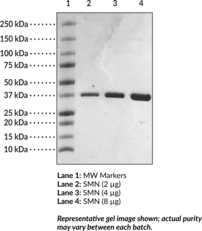
Pure human recombinant protein
Technical Support & Resources

Visit our FAQ

Contact Us

Toll Free Phone (USA and Canada Only): (888) 526-5351
Direct Phone: (734) 975-3888

Request Technical Support

Technical Support Request

To streamline the process attach the appropriate questionnaire to your inquiry.

Download IHC QuestionnaireDownload WB Questionnaire

View Our Privacy Statement for details on how we use and protect your data. In addition, this site is protected by hCaptcha and its Privacy Policy and Terms of Service apply.

SMN tudor domain (human recombinant)

Item No. 14136

Technical Information
Synonyms
  • Component of Gems 1
  • Gemin-1
  • Survival Motor Neuron Protein
Purity
≥90% estimated by SDS-PAGE
Source
Recombinant N-terminal GST-tagged protein expressed in E. coli
Amino Acids
73-173 of Uniprot No. Q16637 fused to an N-terminal GST-tag and linker
MW
37.9 kDa
50 mM Tris-HCl, with 150 mM sodium chloride, pH 8.0, containing 20% glycerol
UniProt Accession №
Q16637
Shipping & Storage Information
Storage
-80°C
Shipping
Dry ice in continental US; may vary elsewhere
Recommended Products

Certificates of Analysis & Batch Specific Data

Provide batch numbers separated by commas to download or request available product inserts, QC sheets, certificates of analysis, data packs, and GC-MS data.

    Add

    Cayman Chemical
    Visit Our Cancer Resource Center
    Find Tools & Resources to Study the Hallmarks of Cancer
    • Cancer cell signaling & regulation
    • Cancer metabolism
    • Tumor microenvironment
    EXPLORE NOW
    Product Description

    Tudor domains are small protein structural motifs of ~50 amino acids related to the “Royal family” of methyl readers, which also includes chromo, MBT, PWWP, and Agenet-like domains.1,2 Tudor domains occur either alone, in tandem, or with other domains and are found in many proteins that are involved in RNA metabolism, germ cell development, transposon silencing, DNA damage response, histone modification and chromatin remodeling.3 The tudor domains recognize symmetric methylated arginine or methylated lysine residues.4,5,6,7 The Survival of Motor Neurons (SMN) protein participates in RNA splicing. The Tudor domain of SMN recognizes and binds methylated Sm proteins, which bind small nuclear RNA.8 SMN is encoded in humans by two separate genes, SMN1 and SMN2, which differ by one base in exon 7. In motor neuron cells, approximately 90% of the SMN2 transcripts are spliced to exclude exon 7.9 The SMN2 transcripts without exon 7 are less stable than SMN1 transcripts.10 Consequently, defects in human SMN1 result in the death of motor neuron cells and spinal muscular atrophy, which is the leading genetic cause of infantile death. This protein product contains the tudor domain region of SMN. The sequence of this region is identical in both the SMN1 and the SMN2 genes.

    WARNING This product is not for human or veterinary use.

    References & Product Citations
    Product Description References

    1. Maurer-Stroh, S., Dickens, N.J., Hughes-Davies, L., et alThe Tudor domain 'Royal Family': Tudor, plant Agenet, Chromo, PWWP and MBT domains. Trends Biochem. Sci. 28(2), 69-74 (2003).

    2. Lasko, P. Tudor domain. Curr. Biol. 20(16), R666-R667 (2010).

    3. Chen, C., Nott, T.J., Jin, J., et alDeciphering arginine methylation: Tudor tells the tale. Nat. Rev. Mol. Cell Biol. 12(10), 629-642 (2011).

    4. Kim, J., Daniel, J., Espejo, A., et alTudor, MBT and chromo domains gauge the degree of lysine methylation. EMBO Rep. 7(4), 397-403 (2006).

    5. Huang, Y., Fang, J., Bedford, M.T., et alRecognition of histone H3 lysine-4 methylation by the double tudor domain of JMJD2A. Science 312(5774), 748-751 (2006).

    6. Lee, J., Thompson, J.R., Botuyan, M.V., et alDistinct binding modes specify the recognition of methylated histones H3K4 and H4K20 by JMJD2A-tudor. Nat. Struct. Mol. Biol. 15(1), 109-111 (2008).

    7. Sprangers, R., Groves, M.R., Sinning, I., et alHigh-resolution X-ray and NMR structures of the SMN tudor domain: Conformational variation in the binding site for symmetrically dimethylated arginine residues. J. Mol. Biol. 327(2), 507-520 (2003).

    8. Burghes, A.H.M., and Beattie, C.E. Spinal muscular atrophy: Why do low levels of SMN make motor neurons sick? Nat. Rev. Neurosci. 10(8), 597-609 (2009).

    9. Ruggiu, M., McGovern, V.L., Lotti, F., et alA role for SMN exon 7 splicing in the selective vulnerability of motor neurons in spinal muscular atrophy. Mol. Cell Biol. 32(1), 126-138 (2012).

    10. Cobb, M.S., Rose, F.F., Rindt, H., et alDevelopment and characterization of an SMN2-based intermediate mouse model of spinal muscular atrophy. Hum. Mol. Genet. 22(9), 1843-1855 (2013).