
Features
- Due to limited shelf life and/or restricted production, this product is available as custom order only. Please contact our sales office for pricing and lead time.
Technical Support & Resources
Visit our FAQ
Contact Us
Toll Free Phone (USA and Canada Only): (888) 526-5351
Direct Phone: (734) 975-3888
Product Categories
Product Type
ASH1L bromodomain (human, recombinant)
Item No. 14489
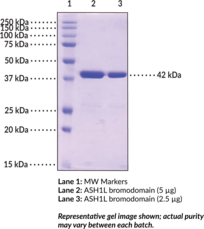
Technical Information
- Absent, Small, or Homeotic Discs 1-like
- ASH1-like, Histone Lysine Methyltransferase Complex Subunit
- Histone Lysine Methyltransferase Complex Subunit
Shipping & Storage Information
Recommended Products
Certificates of Analysis & Batch Specific Data
Provide batch numbers separated by commas to download or request available product inserts, QC sheets, certificates of analysis, data packs, and GC-MS data.
Product Description
The acetylation of histone lysine residues plays a crucial role in the epigenetic regulation of gene transcription. Acetylated lysine residues are recognized by a small protein domain known as a bromodomain.1 These domains function in linking protein complexes to acetylated nucleosomes, thereby controlling chromatin structure and gene expression. Thus, bromodomains serve as “readers” of histone acetylation marks regulating the transcription of target promoters.2 ASH1L is the mammalian homolog of the Drosophila protein Absent, small, or homeotic disc 1 (Ash1), a trithorax group histone methyltransferase involved in gene activation.3 ASH1L contains an associated with SET domain, a SET domain, a post-
WARNING This product is not for human or veterinary use.
References & Product Citations
1. Structure and acetyl-
2. Bromodomains as therapeutic targets. Expert Rev. Mol. Med. 13, e29 (2011).
3. Crystal structure of the human histone methyltransferase ASH1L catalytic domain and its implications for the regulatory mechanism. The Journal of Biological Chemisty 286(10), 8369-8374 (2011).
4. huASH1 protein, a putative transcription factor encoded by a human homologue of the Drosophila ash1 gene, localizes to both nuclei and cell-
5. Dual function of histone H3 lysine 36 methyltransferase ASH1 in regulation of Hox gene expression. PLoS One 6(11), (2011).
6. Mammalian ASH1L is a histone methyltransferase that occupies the transcribed region of active genes. Mol. Cell. Biol. 27(24), 8466-8479 (2007).
Contact Info
Cayman Chemical1180 East Ellsworth RoadAnn Arbor, Michigan 48108 USAToll Free: (800) 364-9897(USA and Canada only)Fax: (734) 971-3640


