
Pure human recombinant protein
Features
  • Due to limited shelf life and/or restricted production, this product is available as custom order only. Please contact our sales office for pricing and lead time.
Technical Support & Resources

Visit our FAQ

Contact Us

Toll Free Phone (USA and Canada Only): (888) 526-5351
Direct Phone: (734) 975-3888

Request Technical Support

Technical Support Request

To streamline the process attach the appropriate questionnaire to your inquiry.

Download IHC QuestionnaireDownload WB Questionnaire

View Our Privacy Statement for details on how we use and protect your data. In addition, this site is protected by hCaptcha and its Privacy Policy and Terms of Service apply.

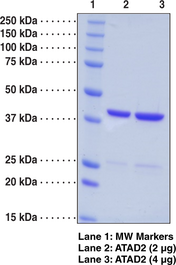
ATAD2 bromodomain (human recombinant)

Item No. 14490
Technical Information
Synonyms
  • ANCCA
  • ATPase Family AAA Domain-containing Protein 2
Purity
≥90%
Source
recombinant N-terminal GST-tagged protein expressed in E. coli
Amino Acids
981-1,108 (partial protein)
MW
43.1 kDa
50 mM Tris, pH 8.0, containing 150 mM sodium chloride and 20% glycerol
UniProt Accession №
Q6PL18
Shipping & Storage Information
Storage
-80°C
Shipping
Dry ice in continental US; may vary elsewhere
Recommended Products

Certificates of Analysis & Batch Specific Data

Provide batch numbers separated by commas to download or request available product inserts, QC sheets, certificates of analysis, data packs, and GC-MS data.

    Add

    Product Description

    The acetylation of histone lysine residues plays a crucial role in the epigenetic regulation of gene transcription. Acetylated lysine residues are recognized by a small protein domain known as a bromodomain.1 These domains function in linking protein complexes to acetylated nucleosomes, thereby controlling chromatin structure and gene expression. Thus, bromodomains serve as "readers" of histone acetylation marks regulating the transcription of target promoters.2 ATAD2 is an AAA+ ATPase-containing nuclear transcriptional coactivator for the estrogen and androgen receptors.3,4 ATAD2 is highly expressed in several types of tumors and has been proposed to link the E2F and MYC signaling pathways. Binding to the MYC oncogene stimulates its transcriptional activity, leading to the development of aggressive cancers with poor prognosis.5 ATAD2 is important for the assembly of chromatin modifying complexes and its bromodomain associates with acetylated lysine 14 on histone H3 to regulate the genes required for cell cycle progression.3,6

    WARNING This product is not for human or veterinary use.

    References & Product Citations
    Product Description References

    1. Mujtaba, S., Zeng, L., and Zhou, M.-M. Structure and acetyl-lysine recognition of the bromodomain. Oncogene 26(37), 5521-5527 (2007).

    2. Muller, S., Filippakopoulos, P., and Knapp, S. Bromodomains as therapeutic targets. Expert Rev. Mol. Med. 13, e29 (2011).

    3. Kalashnikova, E.V., Revenko, A.S., Gemo, A.T., et al. ANCCA/ATAD2 overexpression identifies breast cancer patients with poor prognosis, acting to drive proliferation and survival of triple-negative cells through control of B-Myb and EZH2. Cancer Res. 70(22), 9402-9412 (2010).

    4. Zou, J.X., Revenko, A.S., Li, L.B., et al. ANCCA, an estrogen-regulated AAA+ ATPase coactivator for ERα, is required for coregulator occupancy and chromatin modification. Proc. Natl. Acad. Sci. USA 104(46), 18067-18072 (2007).

    5. Ciró, M., Prosperini, E., Quarto, M., et al. ATAD2 is a novel cofactor for MYC, overexpressed and amplified in aggressive tumors. Cancer Res. 69, 8491-8498 (2009).

    6. Revenko, A.S., Kalashnikova, E.V., Gemo, A.T., et al. Chromatin loading of E2F-MLL complex by cancer-associated coregulator ANCCA via reading a specific histone mark. Mol. Cell. Biol. 30(22), 5260-5272 (2010).

