
Pure human recombinant protein
Features
  • Due to limited shelf life and/or restricted production, this product is available as custom order only. Please contact our sales office for pricing and lead time.
Technical Support & Resources

Visit our FAQ

Contact Us

Toll Free Phone (USA and Canada Only): (888) 526-5351
Direct Phone: (734) 975-3888

Request Technical Support

Technical Support Request

To streamline the process attach the appropriate questionnaire to your inquiry.

Download IHC QuestionnaireDownload WB Questionnaire

View Our Privacy Statement for details on how we use and protect your data. In addition, this site is protected by hCaptcha and its Privacy Policy and Terms of Service apply.

BRD7 bromodomain (human, recombinant)

Item No. 14491
Technical Information
Synonyms
  • Bromodomain containing protein 7
  • Protein CELTIX-1
Purity
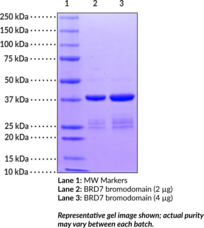
≥70% estimated by SDS-PAGE
Source
recombinant N-terminal GST-tagged protein expressed in E. coli
Amino Acids
129-252 (partial protein)
MW
42.2 kDa
50 mM Tris, pH 8.0, with 150 mM sodium chloride and 20% glycerol
Shipping & Storage Information
Storage
-80°C
Shipping
Dry ice in continental US; may vary elsewhere
Recommended Products

Certificates of Analysis & Batch Specific Data

Provide batch numbers separated by commas to download or request available product inserts, QC sheets, certificates of analysis, data packs, and GC-MS data.

    Add

    Product Description

    The acetylation of histone lysine residues plays a crucial role in the epigenetic regulation of gene transcription. Acetylated lysine residues are recognized by a small protein domain known as a bromodomain.1 These domains function in linking protein complexes to acetylated nucleosomes, thereby controlling chromatin structure and gene expression. Thus, bromodomains serve as “readers” of histone acetylation marks regulating the transcription of target promoters.2 BRD7 is a subunit of the polybromo-associated BRG1-associated factor (PBAF)-specific component of the switch/sucrose non-fermentable chromatin-remodeling complex.3 It has a tumor suppressor role by acting as a cofactor for p53 and regulating breast cancer tumorigenicity.4,5 Cells lacking BRD7 have reduced breast cancer type 1-dependent estrogen receptor α expression.5 Down-regulation of BRD7 has been demonstrated in nasopharyngeal carcinoma cell lines and in colorectal cancer.6,4 BRD7 is also involved in transcriptional gene silencing through binding to protein arginine methyltransferase 5 and polycomb repressive complex 2. This protein product contains the bromodomain region of BRD7.

    WARNING This product is not for human or veterinary use.

    References & Product Citations
    Product Description References

    1. Mujtaba, S., Zeng, L., and Zhou, M.-M. Structure and acetyl-lysine recognition of the bromodomain. Oncogene 26(37), 5521-5527 (2007).

    2. Muller, S., Filippakopoulos, P., and Knapp, S. Bromodomains as therapeutic targets. Expert Rev. Mol. Med. 13, e29 (2011).

    3. Kaeser, M.D., Aslanian, A., Dong, M.Q., et alBRD7, a novel PBAF-specific SWI/SNF subunit, is required for target gene activation and repression in embryonic stem cells. The Journal of Biological Chemisty 283(47), 32254-32263 (2008).

    4. Wu, W.J., Hu, K.S., Chen, D.L., et alPrognostic relevance of BRD7 expression in colorectal carcinoma. Eur. J. Clin. Invest. 43(2), 131-140 (2013).

    5. Mantovani, F., Drost, J., Voorhoeve, P.M., et alGene regulation and tumor suppression by the bromodomain-containing protein BRD7. Cell Cycle 9(14), 2777-2781 (2010).

    6. Peng, C., Liu, H.Y., Zhou, M., et alBRD7 suppresses the growth of nasopharyngeal carcinoma cells (HNE1) through negatively regulating β-catenin and ERK pathways. Mol. Cell. Biochem. 303(1-2), 141-149 (2007).

