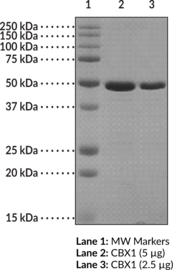
Pure human recombinant protein
Technical Support & Resources

Visit our FAQ

Contact Us

Toll Free Phone (USA and Canada Only): (888) 526-5351
Direct Phone: (734) 975-3888

Request Technical Support

Technical Support Request

To streamline the process attach the appropriate questionnaire to your inquiry.

Download IHC QuestionnaireDownload WB Questionnaire

View Our Privacy Statement for details on how we use and protect your data. In addition, this site is protected by hCaptcha and its Privacy Policy and Terms of Service apply.

CBX1 (human recombinant)

Item No. 14768

Technical Information
Synonyms
  • Chromobox Protein Homolog 1
  • Heterochromatin Protein 1 Homolog β
  • Heterochromatin Protein p25
  • HP1-β
  • HP1Hs-β
  • M31
  • Modifier 1 Protein
  • p25β
Purity
≥95%
Source
Recombinant N-terminal GST-tagged protein expressed in E. coli
Amino Acids
2-184 (full length)
MW
48.9 kDa
50 mM Tris-HCl, pH 8.0, with 150 mM sodium chloride and 20% glycerol
UniProt Accession №
P83916
Shipping & Storage Information
Storage
-80°C
Shipping
Dry ice in continental US; may vary elsewhere
Certificates of Analysis & Batch Specific Data

Provide batch numbers separated by commas to download or request available product inserts, QC sheets, certificates of analysis, data packs, and GC-MS data.

    Add

    Product Description

    The heterochromatin protein 1 (HP1) family, which consists of three isoforms HP1α (CBX5), HP1β (CBX1), and HP1γ (CBX3) are chromatin-associated proteins involved in gene regulation and heterochromatin formation.1 CBX proteins have an N-terminal chromodomain, a C-terminal chromoshadow domain (CSD), and a hinge domain which connects the two.2 Extensive post-translational modifications have been observed and mapped on the CBX proteins.3 The chromodomain of CBX1 has been shown to recognize di- and tri-methylated lysine 9 on histone H3 (H3K9me2 and H3K9me3), with a preference for H3K9me3. Binding of CBX1 to methylated histones leads to gene silencing and heterochromatin formation.1,4 The CSD region of CBX1 is responsible for homodimerization and interaction with a number of non-histone chromatin-associated proteins, including the BRCA2-interacting protein EMSY, which may be involved in the development of breast and ovarian cancer.5,6,7 CBX1 also helps to reorganize chromatin as part of the DNA damage response systems by binding to sites of DNA damage through the CSD region.8,9

    WARNING This product is not for human or veterinary use.

    References & Product Citations
    Product Description References

    1. Lachner, M., O'Carroll, D., Rea, S., et alMethylation of histone H3 lysine 9 creates a binding site for HP1 proteins. Nature 410(6824), 116-120 (2001).

    2. Kwon, S.H., and Workman, J.L. The changing faces of HP1: From heterochromatin formation and gene silencing to euchromatic gene expression. BioEssays 33(4), 280-289 (2011).

    3. LeRoy, G., Weston, J.T., Zee, B.M., et alHeterochromatin protein 1 is extensively decorated with histone code-like post-translational modifications. Mol. Cell. Proteomics 8(11), 2432-2442 (2009).

    4. Kaustov, L., Ouyang, H., Amaya, M., et alRecognition and specificity determinants of the human Cbx chromodomains. The Journal of Biological Chemisty 286(1), 521-529 (2011).

    5. Hughes-Davis, L., Huntsman, D., Ruas, M., et alEMSY links the BRCA2 pathway to sporadic breast and ovarian cancer. Cell 115(5), 523-535 (2003).

    6. Richart, A.N., Brunner, C.I.W., Stott, K., et alCharacterization of the chromoshadow domain-mediated binding of heterochromatin protein 1α (HP1α) to histone H3. The Journal of Biological Chemisty 287(22), 18730-18737 (2012).

    7. Huang, Y., Myers, M.P., and Xu, R.M. Crystal structure of the HP1-EMSY complex reveals an unusual mode of HP1 binding. Structure 14(4), 703-712 (2006).

    8. Luijsterburg, M.S., Dinant, C., Lans, H., et alHeterochromatin protein 1 is recruited to various types of DNA damage. The Journal of Biological Chemisty 185(4), 577-586 (2009).

    9. Dinant, C., and Luijsterburg, M.S. The emerging role of HP1 in the DNA damage response. Mol. Cell. Biol. 29(24), 6335-6340 (2009).